Gut HealthObservational
Case Study: Marked Improvement in 8-Year Chronic Fatigue, IBS, and Brain Fog Using the Functional Health Matrix
Evidence:Cohort studies
Educational composite — not a single patient. This is an illustrative composite of a 38-year-old woman with an eight-year history of chronic fatigue, IBS, and brain fog following an infectious trigger and antibiotic exposure, with iron depletion and small intestinal bacterial overgrowth. It shows how SIBO eradication, mitochondrial support, nutrient repletion, and sleep restoration can rebuild energy and gut function as adjuncts to standard care, under a registered clinician. It does not describe one identifiable patient; names, demographic specifics, and quoted dialogue are constructed for illustration. Supplements are adjuncts, not substitutes. Do not start, stop, or alter any medication yourself — deprescribing decisions are made by the prescribing clinician. Editorial review by Chris Massamba, Dip CNM, FMCHC.
Key learning points
- Post-infectious SIBO can drive chronic fatigue, brain fog, and hormonal disruption years after the initial gut insult, yet is easily overlooked when conventional bloods read as normal.
- Functional reference ranges differ from laboratory population ranges: ferritin 22, B12 298, and TSH 3.1 were each within range yet, in this clinical context, suboptimal.
- The Functional Health Matrix is a clinical-reasoning framework, not a validated diagnostic test; here it placed Assimilation as the root node and sequenced treatment — gut restoration first, then mitochondrial and hormonal support.
- A structured nutritional deficiency review — cross-referenced with NICE Clinical Knowledge Summaries and NIH Office of Dietary Supplements guidance — mapped the picture to specific nutrient insufficiencies before lab confirmation.
- Medication changes are prescriber-led: with neurological symptoms and low-normal B12, refer for haematological review rather than self-treating. Outcomes are illustrative; individual response varies.
Patient Presentation
Emma (a composite, not her real name), a 38-year-old secondary school teacher from Bristol, presented in January 2026 describing herself as "running on empty since 2018."
Patient Presentation
| Field | Detail |
|---|---|
| Name (composite) | Emma |
| Age | 38 |
| Location | Bristol |
| Chief complaints | Chronic fatigue (8 years), post-meal bloating, brain fog |
| Duration | 8 years (onset 2018, post-gastroenteritis) |
| Prior care | Four GP consultations; "post-infectious IBS" and "probably chronic fatigue syndrome"; antidepressants suggested once; no therapeutic plan beyond symptom management |
| Red-flag exclusions | Conventional bloods within NHS reference ranges; no anaemia on FBC; no malignancy markers |
| Relevant history | Severe gastroenteritis on holiday in Morocco, 2018; two courses of broad-spectrum antibiotics (ciprofloxacin, then metronidazole); progressive cold intolerance, dry skin, brittle nails, recurrent mouth ulcers |
In her words: "I wake up exhausted. By 2pm I can barely keep my eyes open. My stomach bloats after every meal. My brain feels wrapped in cotton wool — I re-read emails three times. My libido has vanished. All my bloods are 'normal.'" The acute 2018 infection resolved, but her digestion never fully recovered; over the following years the fatigue deepened and new symptoms accrued.
Interpretation: progressive multi-system decline following a clear infectious trigger and antibiotic exposure, with conventional investigations read as normal — a pattern suggestive of post-infectious gut dysfunction driving downstream nutrient depletion.

Initial Clinical Assessment
Using a structured nutritional deficiency review aligned with NICE Clinical Knowledge Summaries and NIH Office of Dietary Supplements guidance, the practitioner assessed by body system. The signs below are clinical pointers, not diagnoses.
Initial Clinical Assessment
| System | Findings | Nutrients implicated |
|---|---|---|
| General | Marked fatigue; cold intolerance; upper-arm muscle wasting despite stable weight | Iron, magnesium, B1, B12, thyroid, protein-energy |
| Skin | Dry, scaly patches (elbows/shins); easy bruising; fine downy forearm hair (lanugo) | Essential fatty acids, vitamin C, protein-energy |
| Mouth | Recurrent aphthous ulcers (2–3/month); angular cheilitis; atrophic glossitis | Iron, B2, B12, folate |
| Nails | Brittle, flaking, longitudinal ridging | Iron, essential fatty acids |
| Musculoskeletal | Calf pain after minimal walking; generalised aching | B1 (thiamine), magnesium |
| Neurological | "Cotton wool" brain fog; poor short-term memory; tingling in toes | B12, B1, B6, iron, thyroid |
The pattern suggested multi-system nutritional insufficiency arising not from poor intake — Emma ate a varied diet — but from malabsorption secondary to post-infectious gut dysfunction and repeated antibiotic exposure.
Conventional bloodwork (GP-reported "normal"), shown against the practitioner's preferred functional targets (author preference, not a guideline threshold):
Initial Clinical Assessment
| Marker | Result | Functional target |
|---|---|---|
| TSH | 3.1 mIU/L | 0.5–2.0 |
| Ferritin | 22 ng/mL | >50 (with fatigue/hair loss) |
| B12 | 298 pg/mL | >500 (with neurological symptoms) |
| Vitamin D | 42 nmol/L | >75 |
Every marker sat within the laboratory reference range; each was suboptimal against these functional targets (Lord and Bralley, 2012).
Safety call-out (boxed). Peripheral neuropathy, atrophic glossitis, and fatigue with low-normal B12 warrant urgent B12 assessment regardless of population ranges; untreated B12 insufficiency can cause lasting neurological harm. Refer for haematological review if B12 is below 300 pg/mL with neurological symptoms. Do not self-prescribe high-dose B12 ahead of that review.
Functional Health Matrix Assessment
The Functional Health Matrix is a structured clinical-reasoning aid, not a scored instrument with hard thresholds. The practitioner mapped Emma across all 7 nodes (1 = severely impaired, 5 = optimal).
Functional Health Matrix Assessment
| Node | Initial (1–5) | Note |
|---|---|---|
| Structural Integrity | 3 | Upper-arm wasting and deconditioning from fatigue; no primary structural disease |
| Defence & Repair | 2 | 4–5 URTIs/year, slow healing; repeatedly disrupted microbiome (Wang et al., 2020) |
| Energy Production | 1 | Afternoon-predominant fatigue, unrefreshing sleep, exertional intolerance; cofactor deficiencies (Pizzorno, 2014; Nicolson, 2014) |
| Biotransformation & Elimination | 2 | Alternating constipation/loose stools; antibiotic history; EFA-dependent bile flow impaired |
| Transport | 3 | Cold extremities; ferritin 22 ng/mL limiting tissue oxygen delivery; no overt cardiovascular disease |
| Communication | 2 | Flattened cortisol rhythm; suboptimal thyroid (TSH 3.1); low-quartile sex hormones; gut-derived serotonin affected (Carabotti et al., 2015) |
| Assimilation | 1 | Post-infectious IBS with SIBO; bloating 30–60 min post-meal (Pimentel et al., 2020); likely permeable gut barrier driving immune activation |
| Total | 14 / 35 | Severe multi-system functional impairment |
Interpretation: a "gut-collapse" pattern with Assimilation and Energy Production both at 1/5, the amber nodes (Defence, Biotransformation, Communication) reading as secondary cascade effects. This guided sequencing: restore the gut first, then mitochondrial and hormonal support.
From the literature: "The microbiota and the brain communicate with each other via various routes including the immune system, tryptophan metabolism, the vagus nerve and the enteric nervous system." — Cryan et al., Physiol Rev 2019
Wheel of Life Assessment
Emma scored herself 1–10 across the eight dimensions (1–3 crisis, 4–6 needs attention, 7–8 functional, 9–10 thriving).
Wheel of Life Assessment
| Dimension | Initial (1–10) | In her words |
|---|---|---|
| Nutrition & Diet | 4 | "I eat reasonably well, but I'm scared of food because everything bloats me." |
| Sleep & Recovery | 2 | "I sleep 8–9 hours but never feel rested." |
| Movement & Exercise | 1 | "I used to run. Now walking to the car is hard." |
| Stress Management | 3 | "Teaching is stressful. I just push through." |
| Relationships & Community | 6 | "My partner is supportive; I've withdrawn from friends because I'm too tired." |
| Purpose & Meaning | 7 | "I love teaching — it's the only thing keeping me going." |
| Environment & Toxins | 5 | "I don't smoke; 2–3 glasses of wine a week." |
| Spiritual Practice | 3 | "I used to do yoga. I miss it." |
| Total | 31 / 80 | A flat wheel |
Interpretation: the wheel was most collapsed on the physical axis (Movement 1, Sleep 2), with stress and spiritual dimensions also low. The relative preservation of Purpose (7) and Relationships (6) were protective anchors. We prioritised sleep and work-stress before intense exercise, mirroring the depleted FHM.
Functional Testing Ordered
Functional Testing Ordered
| Test | Rationale |
|---|---|
| GI-MAP comprehensive stool analysis | Microbiome composition, pathogens, elastase, calprotectin, secretory IgA |
| Lactulose breath test (SIBO) | Confirm suspected small intestinal bacterial overgrowth |
| Organic Acids Test (OAT) | Mitochondrial intermediates, yeast markers, neurotransmitter metabolites |
| DUTCH Complete | Cortisol rhythm, sex-hormone metabolism, melatonin, oxidative stress |
| Advanced thyroid panel | TSH, free T4/T3, reverse T3, TPO and thyroglobulin antibodies |
| Full iron panel | Serum iron, ferritin, transferrin saturation, TIBC |
For testing rationale, see Essential Functional Medicine Labs for 2026.
Key findings
Key findings
| Panel | Key results (reference range) |
|---|---|
| GI-MAP / breath test | Methane peak 68 ppm (<10) confirming intestinal methanogen overgrowth (Rezaie et al., 2017); elastase borderline 198 µg/g (>200); calprotectin 128 µg/g (<50); secretory IgA 380 µg/g (510–2010) |
| Organic Acids | Citric-acid-cycle intermediates at 25–40% of expected (Lord and Bralley, 2012); elevated arabinose; raised beta-hydroxybutyrate; low VMA |
| DUTCH | Flattened cortisol curve with low morning cortisol (Jones and Quinn, 2010); low-quartile DHEA-S; 4-OH oestrogen preference |
| Thyroid | TSH 3.6 mIU/L; low-quartile free T3; raised reverse T3; TPO antibodies 78 IU/mL — Hashimoto's thyroiditis |
| Iron | Ferritin 18 ng/mL; transferrin saturation 14% — iron deficiency without anaemia (Gaby, 2017) |
The deficiency picture mapped to NICE CKS guidance on iron and B12/folate deficiency and NIH ODS fact sheets: angular cheilitis (B2, iron) and atrophic glossitis (B12, folate, iron) corroborated by low iron and borderline B2; calf pain on exertion fit a B1 picture (untested) supported by the mitochondrial OAT findings.
Intervention Protocol
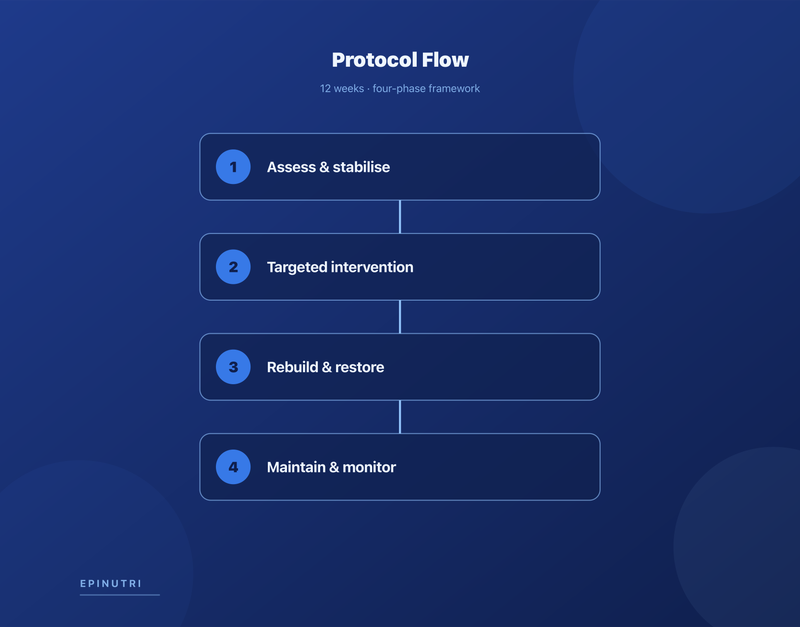
All supplements below are adjuncts introduced under clinical supervision, alongside dietary and lifestyle change; no prescription medication was altered without the prescribing clinician.
Phase 1 — Stabilise (Weeks 0–4)
Phase 1 — Stabilise (Weeks 0–4)
| Domain | Intervention |
|---|---|
| Gut (SIBO eradication) | Allicin 450 mg BD; oregano oil (70% carvacrol) 200 mg BD; berberine HCl 500 mg TDS; partially hydrolysed guar gum 5 g daily (Ruscio, Guard and Pizzorno, 2016; Pimentel et al., 2020) |
| Nutrition | Low-FODMAP diet for 4 weeks to reduce fermentable substrate |
| Gut barrier | L-glutamine 5 g BD; zinc carnosine 75 mg BD; vitamin D3 5,000 IU daily, target 75–100 nmol/L (Murray and Pizzorno, 2012) |
| Medication | None changed; existing prescriptions reviewed with the GP, none requiring deprescribing |
The migrating motor complex and fermentable load were addressed together: partially hydrolysed guar gum feeds beneficial flora during eradication, reducing die-off severity. See the 5R gut restoration framework for the wider rationale.
Phase 2 — Deepen (Weeks 4–8)
Phase 2 — Deepen (Weeks 4–8)
| Domain | Intervention |
|---|---|
| Mitochondrial support | CoQ10 (ubiquinol) 200 mg; nicotinamide riboside 300 mg; alpha-lipoic acid 300 mg BD; acetyl-L-carnitine 1,000 mg; activated B complex (benfotiamine 150 mg, R5P 50 mg, niacinamide 500 mg, B5 500 mg, P5P 50 mg) (Nicolson, 2014; Mantle and Hargreaves, 2019; Manna and Jain, 2015) |
| Nutrient repletion | Iron bisglycinate 28 mg with vitamin C 500 mg; methylcobalamin 5,000 µg sublingual; methylfolate 800 µg (Gaby, 2017; Prousky, 2012) |
| Nutrition | Gradual FODMAP reintroduction; mitochondrial-supportive foods (grass-fed red meat, wild salmon, leafy greens, polyphenol-rich berries) |
| Sleep | Magnesium glycinate 400 mg at bedtime (Abbasi et al., 2012) |
Mitochondrial support is presented as adjunctive: the evidence for CoQ10 and carnitine is supportive rather than definitive, and repletion was layered only once absorption had begun to recover. The reinoculation phase guided probiotic reintroduction.
From the literature: "Mitochondrial dysfunction has been implicated in the pathophysiology of a number of common chronic diseases, including … chronic fatigue syndrome." — Nicolson, Integr Med 2014
Phase 3 — Consolidate (Weeks 8–12)
Phase 3 — Consolidate (Weeks 8–12)
| Domain | Intervention |
|---|---|
| Sleep | 10pm bedtime, 30-minute screen-free wind-down; 15 minutes morning light; sleep rose from ~5.5 to ~7.5 hours within 3 weeks |
| Movement | Walking 15→30 minutes daily; yoga twice weekly; no high-intensity work until energy stabilised (Nicolson, 2014) |
| Stress | 4-7-8 breathing (5 min); no work email after 7pm; alcohol paused for the protocol period |
| Spiritual | Restarted yoga for mind-body connection, not exertion |
Interpretation: the phased approach avoided overwhelming a depleted system — gut first to unlock absorption, then mitochondrial cofactors, then lifestyle rebalancing once energy permitted activity.
Evidence tier summary
Evidence tier summary
| Intervention | Evidence tier | Key sources |
|---|---|---|
| SIBO eradication (herbal antimicrobials) | Moderate (RCTs) | Pimentel et al. 2020; Chedid et al. 2014 |
| CoQ10 for mitochondrial support | Moderate (RCTs + mechanistic) | Mantle and Hargreaves 2019; Nicolson 2014 |
| L-glutamine for gut barrier repair | Moderate (RCTs) | Murray and Pizzorno 2012 |
| Iron bisglycinate repletion | Strong (systematic reviews) | NICE 2024; NIH 2024 |
| Magnesium glycinate for sleep | Moderate (RCTs) | Abbasi et al. 2012 |
| Nicotinamide riboside (NAD+ precursor) | Emerging (mechanistic + pilot) | Pizzorno 2014 |
Interpretation: core interventions rest on moderate-to-strong evidence; nicotinamide riboside remains emerging and was included on mechanistic grounds, framed as such.
Outcomes at 12 Weeks
Emma described feeling "more like herself than I have in years": bloating eased by roughly 90%, bowels normalised to once-daily and formed, brain fog lifted ("I can read a book again"), energy rose from about 2/10 to 7/10, and libido returned. These reflect a composite pattern; individual response varies with dysbiosis severity, nutrient depletion, adherence, and co-existing conditions.
Repeat testing at Week 12:
Outcomes at 12 Weeks
| Marker | Baseline → Week 12 | Note |
|---|---|---|
| Methane (breath test) | 68 → 12 ppm | SIBO effectively eradicated |
| Ferritin | 18 → 48 ng/mL | Approaching target |
| B12 | 298 → 642 pg/mL | Within target |
| Vitamin D | 42 → 86 nmol/L | At target |
| TSH | 3.6 → 1.8 mIU/L | Conversion improved |
| Calprotectin | 128 → 32 µg/g | Inflammation settled |
Functional Health Matrix re-score:
Outcomes at 12 Weeks
| Node | Baseline | 12 Weeks | Change |
|---|---|---|---|
| Structural Integrity | 3 | 5 | +2 |
| Defence & Repair | 2 | 4 | +2 |
| Energy Production | 1 | 5 | +4 |
| Biotransformation & Elimination | 2 | 4 | +2 |
| Transport | 3 | 4 | +1 |
| Communication | 2 | 4 | +2 |
| Assimilation | 1 | 5 | +4 |
| Total | 14 / 35 | 31 / 35 | +17 points |
Interpretation: the largest gains were in Assimilation and Energy Production (+4 each) — the two root nodes targeted by SIBO eradication and mitochondrial support. Communication (+2) reflected improved thyroid conversion and HPA regulation. This is a single composite case, not a trial.
Wheel of Life re-score:
Outcomes at 12 Weeks
| Dimension | Baseline | 12 Weeks | Change |
|---|---|---|---|
| Nutrition & Diet | 4 | 9 | +5 |
| Sleep & Recovery | 2 | 9 | +7 |
| Movement & Exercise | 1 | 8 | +7 |
| Stress Management | 3 | 8 | +5 |
| Relationships & Community | 6 | 9 | +3 |
| Purpose & Meaning | 7 | 9 | +2 |
| Environment & Toxins | 5 | 8 | +3 |
| Spiritual Practice | 3 | 7 | +4 |
| Total | 31 / 80 | 67 / 80 | +36 points |
Interpretation: Sleep (+7) and Movement (+7) improved most, reflecting how restored energy compounds into sleep quality and exercise tolerance. The wheel was no longer flat.
Emma's words: "I didn't realise how unwell I'd become until I started feeling better. I'd normalised exhaustion. Now I have good days far more often than bad ones, and I know what to keep doing to protect that."
Maintenance: a bedtime prokinetic (ginger 1,000 mg + artichoke 500 mg) for 3 months to support migrating motor complex function (Pimentel et al., 2020); ongoing CoQ10 100 mg, magnesium 300 mg, and B complex; dietary iron focus with cycle awareness; sustained sleep hygiene; yoga and daily walking; repeat GI-MAP and OAT at 6 months.
Clinical Pearls
- Gut first. Emma's fatigue, brain fog, and hormonal disruption were plausibly downstream of post-infectious SIBO and malabsorption; restoring the gut unlocked the rest (Pimentel et al., 2020; Bland, 2014).
- "Within range" is not "optimal" — in context. Ferritin 18 and B12 298 with neuropathy warranted action; reference ranges are population statistics, not individual targets (Lord and Bralley, 2012). This is a clinical judgement, not a hard threshold.
- The Matrix sequences, it does not diagnose. As a reasoning framework it made the interconnections visible and ordered the work — gut, then mitochondria, then lifestyle (Jones and Quinn, 2010).
- Bedside signs precede labs. Angular cheilitis, atrophic glossitis, and exertional calf pain pointed to the deficiency pattern before bloods confirmed it.
- Medication safety stays prescriber-led. Low-normal B12 with neurological signs is a referral, not a self-treatment; deprescribing or dose changes are decisions for the prescribing clinician, made proactively.
- Match exertion to capacity. High-intensity exercise on depleted mitochondria worsens fatigue; gentle movement until energy is biochemically restored (Nicolson, 2014).
Internal navigation
If this case study resonated, you may find these clinically relevant. If you recognise similar symptoms — persistent fatigue, post-meal bloating, brain fog, or several "normal" results despite feeling unwell — consider working with a qualified practitioner. For a medical emergency call 999; for urgent non-emergency advice, NHS 111; in distress, Samaritans 116 123 or text SHOUT to 85258.
- The 5R Gut Health Protocol for 2026 — the framework behind Emma's gut restoration.
- Mitochondrial Restoration Protocol — the evidence base for CoQ10, NAD+ precursors, and carnitine used in Phase 2.
- Essential Functional Medicine Labs for 2026 — the testing logic behind GI-MAP, OAT, DUTCH, and thyroid panels.
- Case Study: Rheumatoid Arthritis Remission — another composite where gut-directed work eased a systemic inflammatory condition.
- Case Study: Long COVID Fatigue and Mitochondrial Restoration — the same mitochondrial protocol in a post-viral context.
References
- [1]Abbasi, B., Kimiagar, M., Sadeghniiat, K., Shirazi, M.M., Hedayati, M (2012) ‘and Rashidkhani, B’, (
- [2]Bland, J.S (2014) ‘(2014) The Disease Delusion: Conquering the Causes of Chronic Illness for a Healthier, Longer, and Happier Life’, New York: HarperWave
- [3]Carabotti, M., Scirocco, A., Maselli, M.A (2015) ‘and Severi, C’, (
- [4]Chedid, V., Dhalla, S., Clarke, J.O., Roland, B.C., Dunbar, K.B., Koh, J., Justino, E., Tomakin, E (2014) ‘and Mullin, G.E’, (. doi:10.7453/gahmj.2014.019
- [5]Cryan, J.F., O'Riordan, K.J., Cowan, C.S.M., Sandhu, K.V., Bastiaanssen, T.F.S., Boehme, M., Codagnone, M.G., Cussotto, S., Fulling, C., Golubeva, A.V., Guzzetta, K.E., Jaggar, M., Long-Smith, C.M., Lyte, J.M., Martin, J.A., Molinero-Perez, A., Moloney, G., Morelli, E., Morillas, E., O'Connor, R., Cruz-Pereira, J.S., Peterson, V.L., Rea, K., Ritz, N.L., Sherwin, E., Spichak, S., Teichman, E.M., van de Wouw, M., Ventura-Silva, A.P., Wallace-Fitzsimons, S.E., Hyland, N., Clarke, G (2019) ‘and Dinan, T.G’, (. doi:10.1152/physrev.00018.2018
- [6]Gaby, A.R (2017) ‘(2017) Nutritional Medicine’, 2nd edn
- [7]Jones, D.S (2010) ‘and Quinn, S’, (eds.) (
- [8]Lord, R.S (2012) ‘and Bralley, J.A’, (
- [9]Manna, P (2015) ‘and Jain, S.K’, (. doi:10.3164/jcbn.14-111
- [10]Mantle, D (2019) ‘and Hargreaves, I’, (. doi:10.3390/antiox8020044
- [11]Murray, M.T (2012) ‘and Pizzorno, J’, (
- [12]Nicolson, G.L (2014) ‘(2014) 'Mitochondrial dysfunction and chronic disease: treatment with natural supplements', Integrative Medicine: A Clinician's Journal, 13(4), pp’, 35-43
- [13]Pimentel, M., Saad, R.J., Long, M.D (2020) ‘and Rao, S.S.C’, (. doi:10.1001/jama.2019.20326
- [14]Pizzorno, J (2014) ‘(2014) 'Mitochondria — fundamental to life and health', Integrative Medicine: A Clinician's Journal, 13(2), pp’, 8-15
- [15]Prousky, J (2012) ‘(2012) Textbook of Integrative Clinical Nutrition’, Toronto: CCNM Press
- [16]Rezaie, A., Buresi, M., Lembo, A., Lin, H., McCallum, R., Rao, S., Schmulson, M., Valdovinos, M., Zakko, S (2017) ‘and Pimentel, M’, (. doi:10.1038/ajg.2017.46
- [17]Ruscio, M., Guard, G (2016) ‘and Pizzorno, J’, (
- [18]Stewart, A (2024) ‘(2024) Deficiency Symptoms and Signs — Comprehensive Summary (practitioner reference guide)’, Available at: http://www.stewartnutrition.co.uk/nutritional_assesment/deficiency_symptoms_and_signs.html (Accessed: 8 May. www.stewartnutrition.co.uk
- [19]Wang, Y., Wu, Y., Wang, Y., Xu, H., Mei, X., Yu, D (2020) ‘and Li, W’, (. doi:10.3390/nu12041060
Written by


EPINUTRI Editorial Team
Clinical Content Team
Medical disclaimer: The content in this article is for informational purposes only and does not constitute medical advice, diagnosis, or treatment. Always consult a qualified healthcare professional before making any changes to your health regimen. Individual results may vary. If you are experiencing a medical emergency, please contact 999 immediately.
Related Protocols
- Gut Healthstrong
- Leaky Gut Supportmoderate
- Dysbiosis Managementmoderate
Related Articles

Gut HealthObservational
Case Study: Severe Bloating and Anxiety in a 29-Year-Old Woman — SIBO Eradication and Gut-Brain Axis Restoration Using the Functional Health Matrix
Educational composite — not a single patient. This case study is an illustrative composite of a 29-year-old woman with d...
EPINUTRI Editorial Team5 Jun 202621 min

Gut HealthObservational
Case Study: Paediatric Eczema Remission in a 7-Year-Old Boy — Food-Sensitivity Elimination and Gut Microbiome Restoration Using the Functional Health Matrix
Educational composite — not a single patient. This is an illustrative composite of a 7-year-old boy with chronic, treatm...
EPINUTRI Editorial Team1 Jun 202621 min

Gut HealthRCT
The 5R Gut Health Protocol: A Functional Medicine Framework for 2026
Why a structured framework still matters Most patients with chronic gut symptoms do not arrive in clinic because we lack...
 Chris Massamba30 May 202624 min