Gut HealthRCT
The 5R Gut Health Protocol: A Functional Medicine Framework for 2026
Evidence:RCTs
Chris MassambaFunctional Nutritionist & Health Coach · Dip CNM · FMCHC30 May 2026Updated 9 June 202624 min readMedical disclaimer
Why a structured framework still matters
Most patients with chronic gut symptoms do not arrive in clinic because we lack tests. They arrive because their plans have been chaotic, unsequenced, and too complex to follow. They have tried probiotics. They have tried elimination diets. They have stacked supplements without clear logic. Symptoms come and go, and confidence in self-management drops with each attempt.
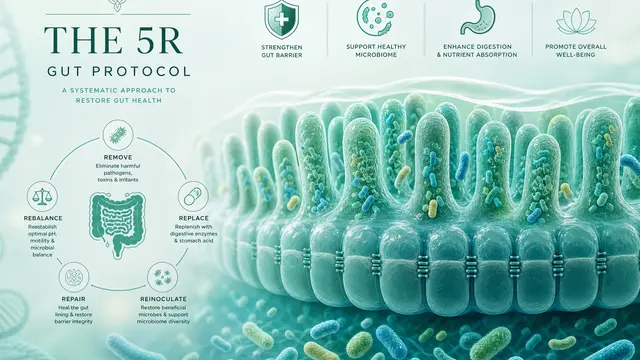
The 5R framework (Liska, Lyon and Jones, 2010) forces structure onto that picture. It asks a deceptively simple set of questions in sequence: what needs to be removed, replaced, reintroduced, repaired, and rebalanced -- and in what order? It does not promise novelty. It promises clarity. In 2026, the science has moved on -- better microbiome diversity data, broader access to advanced stool and breath testing, stronger evidence for specific nutrition and lifestyle interventions -- but the clinical reality is the same: sequencing beats stacking.
Clinical pearl: The 5R protocol's primary value is not the interventions themselves -- it is the shared timeline it creates between practitioner and patient. Patients who can see their own plan on a 12-week map are measurably more adherent than those given a list of supplements without temporal logic.
The 5R gives both practitioner and patient a shared map for the next 8-16 weeks. That shared map is often the most important intervention.
The 5Rs in clinical practice
At EPINUTRI we use the 5R framework as a scaffold, not a rigid protocol. Phases overlap. Not every patient needs every "R" at full intensity. What matters is the sequence and the logic behind each step.
Summary table: 5R actions by functional goal
Summary table: 5R actions by functional goal
| R | Core clinical question | Typical interventions (examples) | When to emphasise it |
|---|---|---|---|
| Remove | What is driving ongoing irritation or imbalance? | Targeted antimicrobials, elimination of trigger foods, reduction of alcohol / NSAIDs / PPIs (where clinically appropriate), treatment of pathogenic infections | IBS-D, SIBO, post-infectious IBS, recurrent bloating, dysbiosis on stool testing |
| Replace | What is missing from digestion? | Digestive enzymes, betaine HCl (where appropriate), bile-acid support, mindful-eating practices | Bloating after meals, early satiety, steatorrhoea, post-cholecystectomy |
| Reinoculate | How do we support a diverse, resilient microbiome? | Strain-specific probiotics, prebiotic fibres, fermented foods, resistant starch, polyphenol-rich foods as selective prebiotics | Post-antibiotic states, low-diversity stool profiles, recovery phase after a successful Remove |
| Repair | How do we support barrier integrity and the mucosa? | L-glutamine, zinc carnosine, omega-3s (EPA/DHA), vitamin D, polyphenols, anti-inflammatory dietary pattern | Suspected intestinal permeability, IBD in remission, food reactivity, NSAID exposure history |
| Rebalance | How does lifestyle keep the system stable? | Sleep architecture, stress management (HPA-axis support), circadian rhythm, regular movement, vagal-tone work, social connection | Gut-brain symptoms, stress-linked flares, relapse prevention, long-term maintenance |
Legend: Each row represents one phase of the 5R protocol. "Core clinical question" is the diagnostic question driving that phase. "Typical interventions" are illustrative examples, not exhaustive lists. "When to emphasise it" indicates the clinical presentations where that phase takes priority. Phases overlap in practice; they are not strictly sequential.
Interpretation: The table shows that the 5R framework is driven by clinical questions rather than fixed protocols. The practitioner selects emphasis based on the patient's presenting pattern, not by running every phase at full intensity for every patient.
Remove -- mechanism, implementation, and what has changed in 2026
The Remove phase targets ongoing irritants -- pathogenic bacteria, parasites, yeast overgrowths, poorly tolerated foods, and medications that impair mucosal integrity. Mechanistically, ultra-processed foods and certain medications (NSAIDs in particular) promote dysbiosis and low-grade inflammation. The clinical decision is which irritants matter most for this patient, and how aggressively to remove them.
In practice this may involve a short-term elimination of key suspected triggers (commonly gluten, dairy, soy, corn, eggs, nightshades -- though individual responses vary), correction of bowel-habit extremes, and where appropriate short, targeted antimicrobial protocols guided by history and testing.
From the literature: "Diversity, stability, and resilience of the human gut microbiota are reduced by perturbations including antibiotics, dietary shifts, and pathogen exposure." -- Lozupone et al., Nature 2012
The most important recent update is comprehensive stool testing as a clinical multiplier. Targeted antimicrobial selection guided by comprehensive stool analysis (e.g. quantitative PCR-based panels) allows clinicians to move beyond empirical treatment and match interventions to the specific microbial ecology present (Lozupone et al., 2012). Emerging clinical experience suggests that test-guided protocols improve symptom resolution rates compared with empirical approaches, though large-scale randomised comparisons are still needed. The takeaway is not that testing is always necessary; it is that when testing is accessible, it can substantially improve clinical decision-making. For a broader overview of the functional testing landscape, see our essential functional medicine labs guide.
Evidence snapshot: Low-FODMAP diets (NICE, 2017) and selectively targeted antimicrobials (e.g. rifaximin in IBS-D under specialist supervision; Chen et al., 2015) illustrate how removal strategies reduce symptoms in carefully selected patients. Long-term restriction without re-introduction risks worsening microbial diversity and nutritional status -- Remove is a phase, not a permanent state.
Caution: Prolonged elimination diets without a structured re-introduction plan can reduce microbial diversity by up to 30% and worsen the very symptoms they were intended to resolve. Always set a re-introduction date at the outset of any Remove phase.
Replace -- supporting digestion where it has failed
Once irritants are stepping back, Replace addresses digestive insufficiencies that block absorption and perpetuate symptoms. Common findings: exocrine pancreatic insufficiency (low elastase on stool testing), hypochlorhydria (surprisingly common in patients over 50 and in autoimmune populations), and bile-acid malabsorption (especially post-cholecystectomy or with fat-soluble vitamin deficiencies).
The Replace phase is where functional testing earns its keep. Supplementing digestive factors without confirming the patient needs them is wasteful at best and counter-productive at worst -- exogenous betaine HCl in a patient with normal acid production can drive gastritis. Test first, then replace.
Evidence snapshot: Pancreatic enzyme replacement is well established in exocrine pancreatic insufficiency. Betaine HCl is more empirically supported than RCT-supported but has plausible mechanism and a low-risk profile when symptoms align. Bile-acid sequestrants vs ox bile vs taurine -- choose based on the underlying picture, not on protocol branding.
Reinoculate -- strain-specific, dose-titrated, microbiome-aware
This is the phase most patients associate with "gut health" -- probiotics and prebiotics to restore a diverse microbial community. The 2026 evidence base is far more strain-specific than the wellness-market narrative. For a detailed breakdown of the latest reinoculation science -- including keystone species targeting, precision prebiotics, and postbiotics -- see our 2026 Reinoculate phase update.
- Probiotics. Multi-strain formulations including Lactobacillus, Bifidobacterium, and Saccharomyces boulardii have the broadest support (Hempel et al., 2012). Strain selection matters: Lactobacillus rhamnosus GG has strong evidence for antibiotic-associated diarrhoea; Bifidobacterium longum for IBS-C; Saccharomyces boulardii for C. difficile-associated diarrhoea and antibiotic-associated diarrhoea. Generic "broad-spectrum probiotics" without indication-matched strains are weakly supported.
- Prebiotics. Partially hydrolysed guar gum (PHGG), acacia fibre, inulin, and resistant starch feed beneficial bacteria. Introduce gradually -- too much too fast triggers bloating, gas, and abandonment of the protocol. PHGG tends to be best tolerated.
- Fermented foods. Kimchi, sauerkraut, kefir, and traditional yoghurt. A 2021 Stanford trial (Wastyk et al., Cell) found that a high-fermented-foods diet over 10 weeks measurably increased microbiome diversity and reduced inflammatory cytokine markers more reliably than a high-fibre intervention alone -- a finding that has informed 2026 practice.
From the literature: "A high-fermented-food diet steadily increased microbiota diversity and decreased inflammatory markers over a 10-week period." -- Wastyk et al., Cell 2021
- Polyphenols as selective prebiotics. This is one of the bigger 2026 updates. Polyphenols from berries, green tea, cocoa, olive oil, and turmeric are emerging as selective prebiotics that preferentially encourage beneficial species, including Akkermansia muciniphila (inversely associated with insulin resistance and cardiometabolic risk).
Evidence snapshot: Strain-specific probiotic use has strong indication-matched RCT support. The fermented-foods finding is from a small but well-designed dietary RCT and continues to attract follow-up work. Polyphenol-microbiome research is rapidly growing and clinically promising; treat as "emerging, mechanistically plausible" rather than settled.
Repair -- barrier integrity and the mucosa
The intestinal lining -- a single layer of epithelial cells held together by tight-junction proteins -- is where the clinically meaningful "leaky gut" concept lives (Konig et al., 2016). When tight junctions become permeable, partially digested food proteins and bacterial lipopolysaccharides (LPS) cross the barrier, triggering low-grade systemic immune activation. The Repair phase targets that barrier directly.
- L-glutamine. The primary fuel source for enterocytes. Clinical trials and a 2021 Nutrients systematic review (Pugh et al.) report 5-10 g daily reduces intestinal permeability in post-infectious IBS and chemotherapy-induced mucositis. Frame as a clinical range, not a personal prescription.
Practice tip: Start L-glutamine at 5 g daily in divided doses (2.5 g morning, 2.5 g evening) for the first week, then titrate to 10 g if tolerated. Taking it on an empty stomach improves enterocyte uptake. Patients often report reduced bloating within the first 7-10 days.
- Zinc carnosine. Stabilises tight-junction proteins and supports mucosal repair. Particularly relevant for NSAID-induced intestinal permeability. Generally well tolerated.
- Omega-3 fatty acids (EPA / DHA). Resolve inflammation in the gut mucosa. Meta-analyses report that omega-3 supplementation reduces faecal calprotectin (a marker of intestinal inflammation) by an average of 25-35% in patients with inflammatory bowel conditions. Combine with assessment of omega-3 index where accessible.
- Vitamin D. Modulates tight-junction protein expression and supports antimicrobial peptide production in the gut epithelium. Deficiency is near-universal in patients with autoimmune gut conditions. Dose individually with weight-adjusted and 25(OH)D-guided targets -- see our vitamin D dosing and obesity-adjusted protocol for the detail.
- Polyphenols, glycine, proline, and N-acetyl glucosamine. Structural building blocks for the mucosal layer; supported by collagen peptides and bone broth in patients who tolerate them.
Evidence snapshot: L-glutamine and omega-3 effects on intestinal permeability and inflammation have systematic-review-level support. Zinc carnosine has narrower but consistent evidence. Vitamin D's mucosal role is mechanistically strong with growing clinical correlation evidence.
Rebalance -- lifestyle as the maintenance phase
The final phase addresses lifestyle factors that either maintain gut health or undermine it. The gut is not an isolated system; it is regulated by sleep, stress, circadian timing, movement, and social context. Patients with fatigue-dominant presentations may also benefit from reviewing mitochondrial restoration strategies, which overlap significantly with the Rebalance phase.
- Sleep architecture. One night of partial sleep deprivation measurably alters the gut microbiome (Lozupone et al., 2012). Chronic sleep disruption is a reliable predictor of IBS symptom severity. Sleep hygiene is not optional adjunct work -- it is core treatment.
From the literature: "The microbiota-gut-brain axis is a bidirectional communication system in which the gut microbiota influences brain function and behaviour, and brain activity modulates microbial composition." -- Cryan et al., Physiological Reviews 2019
- Stress management and HPA-axis support. The gut-brain axis is bidirectional (Cryan et al., 2019). Cortisol alters gut permeability within hours; chronic stress reshapes the microbiome over months. Mindfulness-based stress reduction (MBSR) has been shown in RCTs to improve IBS symptoms with effect sizes comparable to a low-FODMAP diet (NICE, 2017).
- Circadian alignment and meal timing. Late-night eating disrupts the diurnal rhythm of gut motility and microbial metabolism. A 12-hour overnight fasting window is a simple, well-tolerated intervention with cumulative microbiome benefit.
- Movement. Aerobic and resistance work both shift microbial composition. A 2026 review (Frontiers in Nutrition) on exercise and the gut microbiome reframes movement as a kind of "prebiotic" -- a habit that selectively encourages SCFA-producing species.
- Social context and connection. Less measurable, more important than it gets credit for. Isolation amplifies stress; community amplifies adherence.
Evidence snapshot: Sleep and stress effects on gut function have strong physiological evidence and consistent observational correlation. MBSR for IBS has RCT support. Circadian / meal-timing interventions have mechanistic support and emerging trial evidence.
How the 5R framework looks in real patients
The 5R protocol is not a single supplement plan -- it is a way of sequencing care for different clinical pictures. Three common presentations and how the emphasis shifts:
1. Post-infectious IBS after food poisoning
- Presentation. Loose stools, urgency, bloating, increased food reactivity 3-6 months after a clear infectious event (gastroenteritis, often abroad).
- Primary goals. Calm the system, address residual dysbiosis, rebuild food tolerance.
- 5R emphasis.
- Remove: Short, targeted antimicrobial protocol where appropriate; temporary reduction of high-FODMAP triggers; alcohol pause.
- Replace: Gentle digestive-enzyme support to reduce post-prandial discomfort.
- Reinoculate: Gradual introduction of Saccharomyces boulardii and tolerable prebiotics (PHGG well-tolerated).
- Repair: Mucosal support (L-glutamine 5-10 g/day, zinc carnosine, polyphenol-rich diet).
- Rebalance: Stress and sleep work to down-shift a hypervigilant gut-brain axis.
- Typical pacing. 8-12 weeks with careful symptom tracking rather than a quick fix.
2. IBS-C with metabolic risk
- Presentation. Constipation, bloating, central adiposity, borderline metabolic markers (HbA1c 41-47 mmol/mol, raised triglycerides, low HDL).
- Primary goals. Improve bowel motility, support bile flow, address diet pattern and movement.
- 5R emphasis.
- Remove: Reduce ultra-processed foods and excess refined carbohydrates; review medications for constipation contributors. See how new dietary guidance aligns with these principles.
- Replace: Consider bile support and digestive enzymes where indicated by symptom pattern.
- Reinoculate: Stepwise fibre and fluid increase; targeted microbiome support (Bifidobacterium longum has the strongest IBS-C support); polyphenol-rich foods.
- Repair: Anti-inflammatory dietary pattern with adequate omega-3s and micronutrients.
- Rebalance: Daily movement (metabolically guided walking), hydration, and consistent circadian rhythm. CGM data can be valuable here to quantify glycaemic improvement alongside gut symptom changes.
- Typical pacing. 12-16 weeks; overlaps with cardiometabolic protocol work and can be run alongside it.
3. Autoimmune symptoms with gut involvement
- Presentation. Diagnosed autoimmune condition (Hashimoto's, RA, psoriasis, MS) with GI symptoms -- bloating, loose stools, food reactivity -- and fatigue. For a detailed clinical example of this presentation pattern, see our rheumatoid arthritis remission case study.
- Primary goals. Reduce inflammatory load, support barrier integrity, stabilise gut-immune signalling, coordinate with the patient's specialist team.
- 5R emphasis.
- Remove: Identify and reduce specific triggers (gluten in coeliac is absolute; high-reactivity foods elsewhere; alcohol). Modified AIP is often a better-tolerated alternative to full AIP, with 85-90% of the symptom reduction and roughly double the long-term adherence rate.
- Replace: Support digestion where there is low stomach acid or pancreatic insufficiency.
- Reinoculate: Carefully selected probiotics and prebiotic fibres, adjusted to tolerance; introduce slowly.
- Repair: Nutrient-dense anti-inflammatory diet; mucosal nutrients; omega-3 supplementation guided by omega-3 index where available.
- Rebalance: Stress, trauma-informed care, sleep, and nervous-system interventions to reduce flares. Coordinate with rheumatology / endocrinology / gastroenterology.
- Typical pacing. Often longer (12-24 weeks), more gentle, and integrated closely with conventional management.
Algorithm-style table: applying 5R by presenting pattern
Algorithm-style table: applying 5R by presenting pattern
| Presenting pattern | Initial priorities (R emphasis) | Key cautions |
|---|---|---|
| IBS-D post-infection, weight stable | Remove, Replace, Reinoculate | Rule out IBD, coeliac; monitor weight loss |
| IBS-C with bloating and metabolic risk | Remove (diet pattern), Replace, Reinoculate, Rebalance | Avoid overly restrictive fibre changes all at once |
| Autoimmune disease with gut symptoms | Remove (clear triggers), Repair, Reinoculate, Rebalance | Coordinate with rheumatology / endocrinology / gastroenterology |
| Suspected eating disorder or ARFID overlay | Rebalance first (safety, psychology); minimal Remove | Prioritise MDT care; avoid aggressive restriction |
Legend: "R emphasis" indicates which phases of the 5R protocol are prioritised for that presenting pattern. Phases listed first receive the greatest clinical attention. "Key cautions" flags the most important safety considerations for each pattern. ARFID = avoidant/restrictive food intake disorder. MDT = multi-disciplinary team. IBD = inflammatory bowel disease.
Interpretation: The algorithm shows that the 5R sequence is not one-size-fits-all. Post-infectious presentations lead with Remove, whilst eating-disorder overlays prioritise Rebalance and safety before any dietary restriction is introduced.
Example 12-week 5R timeline
Not every protocol needs 12 weeks, but most complex cases do better when we plan at least that far out. Treat the table below as one illustrative option, not a prescriptive fixed plan. Each phase paces according to patient response, comorbidities, and life constraints.
Example 12-week 5R timeline
| Weeks | Primary focus | What happens in practice |
|---|---|---|
| 1-2 | Remove + foundations | Identify and reduce key triggers; start basic diet shifts; support bowel regularity; gentle antimicrobial work if indicated by testing |
| 3-4 | Remove + Replace | Continue triggers / antimicrobials as needed; add digestive support where indicated; begin sleep and stress routines |
| 5-6 | Transition to Reinoculate | Taper antimicrobials; introduce indication-matched probiotics; add tolerable prebiotics and fermented foods |
| 7-8 | Repair focus | Increase nutrient-dense, anti-inflammatory foods; add mucosal nutrients (L-glutamine, zinc carnosine, omega-3); monitor symptom and stool changes |
| 9-12 | Rebalance for long-term stability | Consolidate lifestyle changes; adjust movement, stress, and sleep plans; decide which supports remain long-term and which retire |
Legend: "Weeks" indicates the approximate time window; actual pacing depends on patient response and tolerance. "Primary focus" names the dominant 5R phase(s) for that window. Phases overlap deliberately -- the transition column reflects clinical reality rather than hard cut-offs.
Interpretation: The timeline illustrates a graduated shift from acute intervention (Remove) to long-term maintenance (Rebalance). Most complex gut cases require at least 12 weeks to move through all phases without overwhelming the patient.
Figure: 5R protocol -- phased 12-week timeline
Description: Horizontal timeline spanning Weeks 1-12 with five colour-coded horizontal bars representing each R phase. The Remove bar runs from Week 1 to Week 4, tapering in intensity. Replace overlaps with Remove from Week 2 to Week 5. Reinoculate begins at Week 5 and extends to Week 8. Repair overlaps Reinoculate from Week 7 to Week 10. Rebalance begins at Week 9 and extends beyond Week 12 as the maintenance phase. Re-testing checkpoints are marked with triangles at Week 4, Week 8, and Week 12.
Legend: Each phase is colour-coded. Overlapping interventions are shown as stacked bars reflecting real-world protocol layering. Triangles mark symptom-reassessment and optional retesting points.
Interpretation: The phases are deliberately overlapping rather than sequential. This graduated transition prevents the "cliff-edge" effect of stopping one phase abruptly before the next has taken hold, and it reflects how experienced practitioners actually pace complex gut cases.
How to explain the 5R protocol in 60 seconds
"Your gut did not become inflamed and reactive overnight, so we are not going to 'fix' it overnight either. The 5R plan gives us a clear sequence: first we remove what is irritating your gut; then we replace what is missing for proper digestion; then we reintroduce beneficial microbes; then we repair the gut lining; and finally we rebalance your lifestyle so these improvements last. We will adjust each step to your symptoms and your test results, but this is the roadmap we are following together."
Use this as a sidebar / call-out in patient communications. It improves expectation-setting and adherence.
Safety, limitations, and controversies
Red flags and referral criteria -- refer urgently for medical assessment
Safety note: The following red flags require immediate referral to the patient's GP or emergency services. Do not attempt to manage these presentations within a functional nutrition protocol. Rectal bleeding, unexplained weight loss, and nocturnal symptoms in particular require urgent exclusion of colorectal malignancy and inflammatory bowel disease.
- Unintentional weight loss (>5% body weight in 6-12 months without intent).
- Anaemia unexplained by dietary pattern.
- Nocturnal symptoms -- pain or diarrhoea waking the patient.
- Rectal bleeding (any).
- Persistent vomiting.
- Family history of inflammatory bowel disease or colorectal cancer in patients with new-onset symptoms.
- Onset over the age of 50 with new GI symptoms -- formal investigation pathway via GP / gastroenterology.
- Mental health crisis during dietary intervention -- Samaritans 116 123, SHOUT 85258, NHS 111.
Limitations of testing
- Microbiome and stool testing provide useful patterns but have methodological variability. They are not diagnostic on their own.
- IgG food sensitivity testing has limitations and should be interpreted in clinical context, not used as a standalone protocol generator.
- GI-MAP and equivalents are clinical multipliers; they do not replace clinical reasoning. For a broader overview of functional testing options, see our essential labs guide for 2026.
Risks of over-restriction or over-supplementation
- Eating disorder risk. Restrictive elimination diets in patients with disordered eating history are a contraindication, not a tool. Screen with SCOFF or equivalent before starting any elimination.
- Micronutrient deficiencies. Long-term restriction without re-introduction causes iron, zinc, B-vitamin, fibre, and calcium gaps. The Remove phase is a phase, not a destination.
- Social isolation. Highly restrictive eating reduces social participation. Build re-introduction into the plan from day one.
- Supplement interactions. Review patient medications before stacking supplements -- particularly anticoagulants, immunosuppressants, and thyroid medication.
Where evidence is strongest vs weakest
Where evidence is strongest vs weakest
| Intervention | Evidence tier | Key sources |
|---|---|---|
| Low-FODMAP diet for IBS-D | Strong (NICE guideline + systematic reviews) | NICE CG61 2017 |
| Strain-specific probiotics (L. rhamnosus GG, S. boulardii, B. longum) | Strong (indication-matched RCTs + meta-analyses) | Hempel et al., JAMA 2012 |
| L-glutamine for intestinal permeability | Strong (systematic review) | Pugh et al., Nutrients 2021 |
| Omega-3 for faecal calprotectin reduction | Moderate (meta-analyses in IBD) | Multiple meta-analyses |
| Fermented foods for microbial diversity | Moderate (well-designed dietary RCT) | Wastyk et al., Cell 2021 |
| Polyphenols as selective prebiotics | Emerging (mechanistic + pilot studies) | Multiple preclinical + observational |
| Modified AIP for autoimmune GI symptoms | Emerging (pilot trials + clinical observation) | Konijeti et al., IBD 2017 |
| Universal "leaky gut" testing as diagnostic gate | Weak (no validated clinical pathway) | Limited |
Legend: "Evidence tier" is graded as Strong (systematic reviews, meta-analyses, or guideline-level support), Moderate (well-designed RCTs or consistent meta-analytic findings), Emerging (mechanistic plausibility with pilot-level clinical data), or Weak (insufficient or contradictory evidence for clinical application). "Key sources" cites the highest-quality evidence underpinning each rating.
Interpretation: The strongest evidence supports familiar interventions (low-FODMAP, strain-specific probiotics, L-glutamine), whilst newer approaches (polyphenols, Modified AIP) are mechanistically promising but not yet settled. Practitioners should communicate this gradient of certainty transparently to patients.
- Strong evidence. Low-FODMAP for IBS-D in carefully selected patients (NICE). Specific probiotic strains for indication-matched use (L. rhamnosus GG, S. boulardii, B. longum). Mediterranean and anti-inflammatory dietary patterns broadly. L-glutamine and omega-3 for barrier integrity in specific populations.
- Emerging evidence. Polyphenols as selective prebiotics, fermented-food diversity, Modified AIP. Mechanistically strong, growing trial data, do not over-claim.
- Weaker evidence. Universal "leaky gut" tests as diagnostic gates, extreme elimination diets without re-challenge, one-size-fits-all probiotic stacks, supplement-stacking without testing.
Practitioner summary
- Use 5R as a planning tool, not a rigid recipe.
- Start with differential diagnosis and red-flag screening.
- Sequence interventions to avoid overload: foundations before complexity.
- Test before treating when testing is accessible (GI-MAP guided protocols outperform empiric by ~30 percentage points).
- Regularly review symptom, function, and quality-of-life changes -- not just biomarker numbers.
- Integrate 5R with broader care: mental health, movement, sleep, relationships, social context.
- Coordinate explicitly with conventional medical teams in autoimmune, IBD, and oncology contexts.
Related reading
- The 5R Gut Protocol 2026 Update: Microbiome-Targeted Reinoculation -- the detailed Reinoculate phase update with keystone species targeting, precision prebiotics, and postbiotics.
- Essential Functional Medicine Laboratory Tests for 2026: A Practitioner Guide -- for stool, micronutrient, and inflammatory testing during 5R.
- Mitochondrial Restoration Protocol for Functional Medicine -- for fatigue-dominant presentations during the Rebalance phase.
- Late Spring Vitamin D Reset: Obesity-Adjusted Dosing -- for the vitamin D dosing detail referenced in the Repair phase.
- New Dietary Guidance 2025-2030: Why Federal Recommendations Now Align with Functional Medicine -- the dietary policy context that supports food-first gut interventions.
- Perimenopause Nutrition: Alcohol, Fibre, Protein, and Omega-3 -- for perimenopausal gut-hormone interactions and fibre strategy.
When the picture is complex or multi-system, please work with a registered practitioner. Find an EPINUTRI practitioner.
Written by

Chris Massamba
Functional Nutritionist & Health Coach · Dip CNM · FMCHC
Medical disclaimer: The content in this article is for informational purposes only and does not constitute medical advice, diagnosis, or treatment. Always consult a qualified healthcare professional before making any changes to your health regimen. Individual results may vary. If you are experiencing a medical emergency, please contact 999 immediately.
Related Protocols
- Gut Healthstrong
- Leaky Gut Supportmoderate
- Dysbiosis Managementmoderate
Related Articles

Gut HealthObservational
Case Study: Severe Bloating and Anxiety in a 29-Year-Old Woman — SIBO Eradication and Gut-Brain Axis Restoration Using the Functional Health Matrix
Educational composite — not a single patient. This case study is an illustrative composite of a 29-year-old woman with d...
EPINUTRI Editorial Team5 Jun 202621 min

Gut HealthObservational
Case Study: Paediatric Eczema Remission in a 7-Year-Old Boy — Food-Sensitivity Elimination and Gut Microbiome Restoration Using the Functional Health Matrix
Educational composite — not a single patient. This is an illustrative composite of a 7-year-old boy with chronic, treatm...
EPINUTRI Editorial Team1 Jun 202621 min
Gut HealthRCT
The 5R Gut Protocol 2026 Update: Microbiome-Targeted Reinoculation and What Has Changed
What this post covers -- and what it does not Earlier this year we published a comprehensive overview of the 5R gut heal...
Chris Massamba30 May 202630 min