Gut HealthObservational
Case Study: Severe Bloating and Anxiety in a 29-Year-Old Woman — SIBO Eradication and Gut-Brain Axis Restoration Using the Functional Health Matrix
Evidence:Cohort studies
Educational composite — not a single patient. This case study is an illustrative composite of a 29-year-old woman with debilitating bloating and generalised anxiety associated with small intestinal bacterial overgrowth and gut–brain axis dysfunction. It shows how SIBO eradication, a low-FODMAP elimination with structured reintroduction, vagal-tone restoration, gut-barrier repair, and nutrient repletion can support marked improvement when implemented alongside conventional care. It does not describe one identifiable patient; names, demographic specifics, and quoted dialogue are constructed for illustration. The Functional Health Matrix is a clinical-reasoning framework, not a validated diagnostic test. Do not start, stop, or change any prescribed medication on the basis of this article — all changes are made by your prescribing clinician. Always work with a registered clinician for individual care. Editorial review by Chris Massamba, Dip CNM, FMCHC.
Key learning points
- Severe bloating and anxiety are frequently two expressions of one underlying process: SIBO disrupting the bidirectional gut-brain axis via microbial metabolite signalling, low-grade immune activation, and vagal afferent dysfunction.
- Herbal antimicrobials (oregano oil, berberine) are an adjunct, not a substitute for diet and lifestyle change; trial evidence suggests eradication rates comparable to rifaximin in selected patients, and a week-6 breath test gives objective confirmation.
- Vagal-tone restoration — breathwork, humming, cold facial immersion, diaphragmatic retraining — helps interrupt the feedback loop that perpetuates both gastrointestinal and neuropsychiatric symptoms.
- A young adult with new "IBS and anxiety" dating to a gut infection warrants SIBO testing, not a second psychiatric medication. Anxiety does not always originate in the mind.
- The low-FODMAP diet is a diagnostic and therapeutic tool, not a permanent diet; structured reintroduction prevents nutritional restriction and microbiome narrowing.
- Deprescribing of any anxiolytic or PPI is prescriber-led and proactive; do not self-deprescribe. Outcomes are illustrative and vary with SIBO type, duration, root cause, and adherence.
Patient Presentation
Emma (not her real name), a 29-year-old marketing manager from Bristol, presented in March 2026 after three years of progressively worsening gastrointestinal and neuropsychiatric symptoms that had begun to affect her work and relationships.
In her own words: "I wake up with a flat stomach and by 10 am I look six months pregnant. Some days I can't button my trousers, and I've left meetings because of the pain. But the worst part is the anxiety — I have panic attacks now, racing heart, convinced I'm dying. My GP prescribed sertraline; it helped the panic a little but made the bloating so much worse I stopped. Then I was told it was probably IBS and anxiety feeding each other, given a low-FODMAP leaflet, and sent on my way. No one tested anything."
The timeline showed a clear trigger. In late 2022 she had a severe bout of gastroenteritis whilst travelling in Southeast Asia (vomiting, diarrhoea, fever for ten days). Within weeks of returning she developed new-onset post-meal bloating, erratic bowels alternating between constipation and loose stools, and an intrusive anxiety that felt different from her baseline tendency to worry — "physical, it starts in my stomach and rises into my chest, not the other way around."
Over three years she consulted three GPs and one gastroenterologist, received an IBS diagnosis, and tried mebeverine (no benefit), simethicone (minimal benefit), sertraline (discontinued for GI side effects), and propranolol for situational anxiety (partial benefit). A self-directed three-week low-FODMAP trial gave roughly 40% relief but she could not sustain it or judge when to reintroduce foods. She was taking self-initiated omeprazole 20 mg daily for reflux and drank 3–4 cups of coffee daily for fatigue.

Initial Clinical Assessment
A structured symptom review by body system — informed by the Stewart Nutrition practitioner reference (Stewart, 2024) and aligned with NICE Clinical Knowledge Summaries and NIH Office of Dietary Supplements guidance — alongside conventional labs and red-flag screening.
Initial Clinical Assessment
| Field | Detail |
|---|---|
| Name (composite) | Emma, 29, Bristol |
| Gastrointestinal | Severe postprandial bloating (onset 30–60 min after eating, peak 2–3 h), visible distension, erratic bowels, excessive flatulence, reflux despite omeprazole. Trigger foods (onion, garlic, apples, wheat, legumes, cruciferous) map to FODMAPs (Pimentel and Lembo, 2020) |
| Nervous system | Generalised anxiety (GAD-7 18/21), panic attacks 2–3×/week, brain fog ("thoughts wrapped in cotton wool"), word-finding difficulty, early-morning waking — suggestive of microbiota-gut-brain axis disruption (Cryan et al., 2019) and vagal afferent dysfunction (Breit et al., 2018) |
| Energy | Fatigue worsening through the day, postprandial somnolence, carbohydrate cravings, cold extremities |
| Immune | Frequent URIs (3–4/year), slow recovery, severe gastroenteritis as likely initiating trigger (Pimentel and Lembo, 2020) |
| Musculoskeletal | Eyelid/calf twitching, nocturnal leg cramps, tension headaches 2–3×/week — suggestive of magnesium insufficiency (Stewart, 2024) |
| Skin/mucosa | Dry skin, angular cheilitis, brittle ridged nails |
| Psychological | Interoceptive hypervigilance, catastrophic interpretation of GI sensations, social and work avoidance (Cryan et al., 2019; Berentsen et al., 2022) |
| Red-flag exclusions | No rectal bleeding, no unexplained weight loss, no nocturnal diarrhoea, no family history of colorectal cancer or IBD; coeliac serology negative; CRP normal on NHS testing |
| Medication/supplement history | IBS diagnosis 2023; sertraline discontinued (GI side effects); self-initiated omeprazole; 3–4 coffees daily; rising absenteeism and social withdrawal |
Interpretation: This was not two parallel conditions (IBS and anxiety) but a single, integrated gut-brain axis disorder — initiated by infectious gastroenteritis, perpetuated by SIBO-driven fermentation and low-grade immune activation, and amplified by vagal afferent dysfunction that simultaneously worsened gut motility and signalled threat to the brain (Pimentel and Lembo, 2020; Breit et al., 2018). The earlier sertraline trial had worsened the GI component, a recognised effect on gut motility and microbiome (Bested, Logan and Selhub, 2013). The patient's own description — anxiety "rising from the stomach" — was a precise lay account of vagal afferent signalling driving interoceptive threat perception.
From the literature: "The microbiota-gut-brain axis is a bidirectional communication system... via neural, endocrine, and immune pathways." — Cryan et al., Physiological Reviews 2019
Functional Health Matrix Assessment
Each of the seven nodes was scored 1 (severe dysfunction) to 5 (optimal). The Functional Health Matrix is a structured clinical-reasoning framework, not a scored diagnostic instrument.
Functional Health Matrix Assessment
| Node | Initial (1–5) | Clinical rationale (one line) |
|---|---|---|
| Structural Integrity | 3 | Tension headaches and muscle twitching (magnesium); otherwise intact, exercise avoided due to bloating |
| Defence & Repair | 2 | Frequent URIs, slow recovery; low-grade inflammation from bacterial translocation post-enteritis |
| Energy Production | 2 | Fatigue 6/10, postprandial somnolence, cold extremities; probable magnesium/B-vitamin insufficiency |
| Biotransformation & Elimination | 2 | Erratic bowels impairing elimination; omeprazole altering gastric pH; coffee masking fatigue |
| Transport | 2 | Microvascular effect of systemic inflammation; cold extremities; lymphatic stasis from inactivity |
| Communication | 1 | Critically impaired: HPA dysregulation (GAD-7 18/21), vagal afferent dysfunction, disrupted gut-brain signalling across neural, immune, and metabolic channels (Breit et al., 2018; Cryan et al., 2019) |
| Assimilation | 1 | Root node: hydrogen-dominant post-infectious SIBO driving fermentation, bloating, malabsorption; omeprazole-induced hypochlorhydria compounding it |
| Total Initial Matrix Score | 13 / 35 | Two coupled crisis nodes (Assimilation, Communication) with secondary compromise across Energy, Biotransformation, Transport, Defence |
Interpretation: Assimilation (1) and Communication (1) are causally linked. Post-infectious SIBO generates bacterial metabolites, activates mucosal immunity, and sends vagal afferent signals the brain reads as threat; the resulting anxiety drives sympathetic output that reduces gut motility and worsens SIBO — a self-reinforcing loop. The strategy had to address both nodes at once: eradicate SIBO and restore vagal tone.
Wheel of Life Assessment
Wheel of Life Assessment
| Dimension | Initial (1–10) | Assessment |
|---|---|---|
| Nutrition & Diet | 3 | Fear-driven erratic eating; unsupervised low-FODMAP; high caffeine; omeprazole impairing absorption |
| Sleep & Recovery | 3 | Anxiety-driven 3–4 am waking, racing mind, 5–6 h non-restorative sleep, phone in bed |
| Movement & Exercise | 2 | Previously active; stopped entirely for 14 months due to bloating and bowel urgency |
| Stress Management | 1 | Crisis: GAD-7 18/21, panic 2–3×/week, no practice, hypervigilance, catastrophic thinking amplifying gut symptoms |
| Relationships & Community | 4 | Supportive partner but relationship strained; frequent social cancellations; feels "unreliable" |
| Purpose & Meaning | 5 | Meaningful role but performance anxiety and absenteeism threatening job security |
| Environment & Toxins | 6 | City flat, reasonable air quality; moderate alcohol (4–6 units/week, a noted but uneliminated trigger) |
| Spiritual Practice | 1 | No contemplative practice ("not that kind of person"); open to breathwork framed physiologically |
| Total Initial Wheel of Life Score | 25 / 80 | Crisis in Stress Management and Spiritual Practice (both 1), near-crisis Movement (2), impaired Nutrition and Sleep (both 3) |
Interpretation: The two lowest sectors — Stress Management (1) and Spiritual Practice (1) — reflect active threat physiology rather than mere absence of technique: every GI sensation triggered catastrophic interpretation and sympathetic activation, and Emma had no parasympathetic "off switch". With Movement abandoned (2) and a fear-driven diet (3), the plan prioritised stress and contemplative practice — reframed as physiological vagal interventions — before reintroducing intense exercise. The highest sector, Environment (6), needed least attention.
Functional Testing Ordered
Tests were ordered to confirm the suspected drivers; optimal ranges below are practitioner preferences, not guideline thresholds. For broader context see the functional medicine testing rationale.
SIBO lactulose breath test (3-hour): baseline hydrogen 14 ppm, peak rise to 92 ppm at 90 min (positive: rise >20 ppm above baseline within 90 min); methane negative throughout (peak 6 ppm). Pattern consistent with hydrogen-dominant SIBO; bloating peaked at 60–120 min, tracking peak hydrogen.
Comprehensive stool analysis (Genova GI Effects): faecal calprotectin 74 µg/g (mildly raised, reference <50); pancreatic elastase 312 µg/g (normal, >200); zonulin 128 ng/mL (raised, reference <107, indicating increased intestinal permeability) (Tajik et al., 2020); butyrate low at 3.8 µmol/g (reference >6.0) with total SCFAs below range; reduced Bifidobacterium and Faecalibacterium prausnitzii, raised Streptococcus; no pathogens, ova, or parasites.
Nutritional evaluation: 25-OH vitamin D 32 nmol/L (deficient, optimal >75) (Pineda and McGrath, 2021); RBC magnesium 3.9 mg/dL (low, optimal >5.5) (Stewart, 2024); serum B12 238 pg/mL (borderline, optimal >500); ferritin 28 µg/L (low-normal, optimal >50 premenopausal); Omega-3 Index 4.2% (deficient, optimal >8%); hs-CRP 3.2 mg/L (mildly raised, optimal <1.0).
HPA axis (DUTCH Complete): flattened diurnal cortisol rhythm with borderline-low morning and raised evening cortisol; cortisol awakening response 22% (blunted, optimal >50%); cortisol-to-DHEA ratio suggestive of pregnenolone steal towards cortisol.
Intervention Protocol
The plan addressed Assimilation and Communication in parallel, because they were physiologically coupled. Treating SIBO without restoring vagal tone leaves the motility dysfunction that perpetuates recurrence; treating anxiety without eradicating SIBO leaves the microbial drivers intact. All supplements are adjuncts to diet and lifestyle change, introduced under clinical supervision.
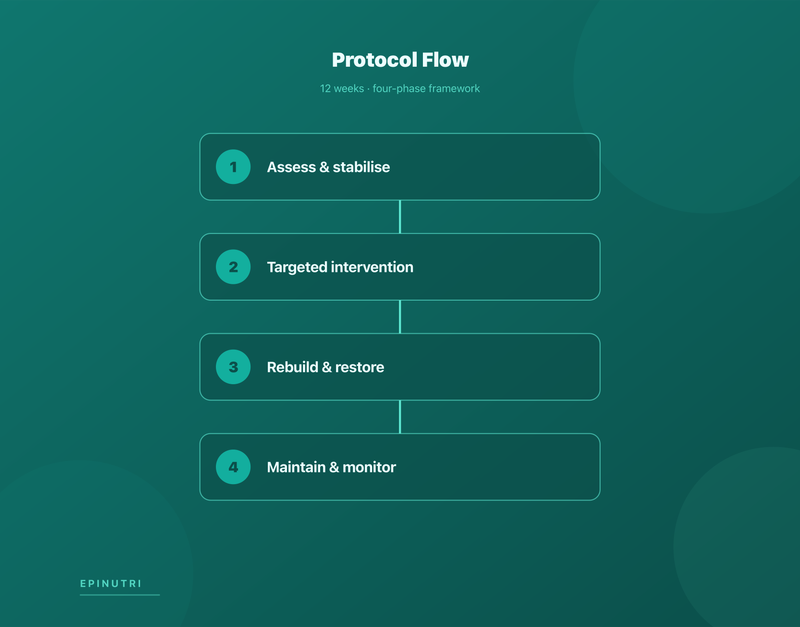
Phase 1: Stabilise — Remove and Restore (Weeks 0–4)
Phase 1: Stabilise — Remove and Restore (Weeks 0–4)
| Domain | Intervention |
|---|---|
| Nutrition | Practitioner-guided low-FODMAP for 4 weeks (onion, garlic, wheat, legumes, lactose, apples, pears, stone fruits, cauliflower, mushrooms, honey, polyols removed); nutrient-dense low-FODMAP staples; meal spacing 3–4 h with no snacking to support the migrating motor complex; coffee, alcohol, and carbonated drinks stopped (NICE, 2022) |
| Supplements | Oregano oil (70% carvacrol) 200 mg TID and berberine HCl 500 mg TID weeks 1–4; PHGG 3 g daily from week 3; L-glutamine 5 g BD; zinc carnosine 75 mg BD; vitamin D3 5,000 IU daily (8-week loading, target >75 nmol/L) |
| Stress / vagal | Diaphragmatic breathing 5 min TID; extended-exhale breathing (4 s in, 8 s out) 5 min at bedtime (Breit et al., 2018); humming 2 min BD; cold-water facial immersion 30 s each morning; vigorous gargling 30 s BD — all framed as vagal stimulation, not relaxation |
| Medication (prescriber-led) | Omeprazole tapered over 3 weeks with DGL liquorice and slippery elm for rebound; betaine HCl titrated with meals to address the reflux mechanism |
Herbal antimicrobials were positioned as an adjunct to the dietary and vagal work, not a stand-alone cure; trial evidence suggests they perform comparably to rifaximin for SIBO eradication (Chedid et al., 2014). Meal spacing matters because the migrating motor complex clears residual small-bowel bacteria between meals. For the underpinning framework see the 5R gut health protocol.
From the literature: "Herbal therapies are at least as effective as rifaximin for resolution of SIBO by lactulose breath testing." — Chedid et al., Global Advances in Health and Medicine 2014
Phase 2: Deepen — Repair and Rebalance (Weeks 4–8)
Phase 2: Deepen — Repair and Rebalance (Weeks 4–8)
| Domain | Intervention |
|---|---|
| Testing | Repeat lactulose breath test at week 6: hydrogen peak 16 ppm (negative), confirming eradication |
| Nutrition | Structured FODMAP reintroduction, one group per 3-day challenge (lactose, excess fructose, sorbitol, mannitol, fructans, GOS); personalised thresholds set (small amounts of onion/garlic tolerated; large apple/pear portions remain triggers; legumes well tolerated in moderation) |
| Supplements | Omega-3 (EPA/DHA) 2,000 mg daily (target Index >8%); magnesium glycinate 400 mg at night; activated B-complex daily; vitamin D3 2,000 IU maintenance; probiotic (Lactobacillus rhamnosus GG + Bifidobacterium longum) for barrier support and vagal-mediated anxiolytic signalling (Cryan et al., 2019) |
| Mind-body | Gut-directed hypnotherapy, 20-min daily audio (RCT-supported for IBS); diaphragmatic breathing extended to 10 min BD |
Phase 3: Consolidate — Integrate and Maintain (Weeks 8–12)
Phase 3: Consolidate — Integrate and Maintain (Weeks 8–12)
| Domain | Intervention |
|---|---|
| Movement | Week 9 daily 15-min post-meal walks; week 10 gentle yin yoga 20 min 3×/week (no inversions); weeks 11–12 graded resistance training 2×/week |
| Sleep | Consistent 22:30–06:30 window; magnesium glycinate 400 mg + glycine 3 g at night; phone removed from bedroom; no screens after 21:00; warm shower, extended-exhale breathing, brief gratitude journal |
| Stress / cognition | Morning vagal reset (cold immersion + humming + diaphragmatic breathing) framed as "physiological hygiene"; cognitive reframing of GI sensations from "threat" to "gut signal"; graded interoceptive exposure during non-symptomatic periods |
| Medication (prescriber-led) | Propranolol stepped from daily 40 mg to as-needed 10–20 mg at week 8, in coordination with her NHS GP; sertraline already discontinued before the consultation; no other prescription medications in use |
Practice tip: For a patient told "it's just anxiety" for years, frame vagal exercises as physiological interventions with measurable outputs — "we're stimulating a nerve", not "try to relax". Patients who have failed at relaxation often succeed at nerve stimulation because it removes performance pressure and matches their experience that the problem is physical.
Medication safety (boxed call-out). Deprescribing is prescriber-led and proactive — decided by the prescribing clinician, not the patient, and never abruptly. Taper PPIs gradually (rebound hyperacidity on withdrawal); reduce anxiolytics such as propranolol only under the GP's direction. SIBO herbal antimicrobials can cause a transient die-off reaction (worsening bloating, fatigue, brain fog), typically days 3–7 — warn patients and distinguish it from treatment failure. Berberine is contraindicated in pregnancy; monitor liver function if treatment exceeds 6 weeks. Alarm features — unintentional weight loss, rectal bleeding, nocturnal symptoms, or a family history of colorectal cancer or IBD — require urgent gastroenterology referral, and coeliac disease and IBD must be excluded before attributing symptoms to SIBO.
Evidence tier summary
Evidence tier summary
| Intervention | Evidence tier | Key sources |
|---|---|---|
| Herbal antimicrobials for SIBO eradication | Strong (RCT) | Chedid et al. 2014 |
| Low-FODMAP diet for IBS/SIBO symptom control | Moderate (RCTs, NICE guidance) | NICE 2022; Pimentel and Lembo 2020 |
| Microbiota-gut-brain axis | Strong (comprehensive reviews + mechanistic studies) | Cryan et al. 2019 |
| Vagus nerve modulation of gut-brain axis | Strong (systematic review) | Breit et al. 2018 |
| Probiotics for anxiety (L. rhamnosus, B. longum) | Moderate (RCTs + meta-analysis) | Cryan et al. 2019 |
| Gut-directed hypnotherapy for IBS | Moderate (RCTs) | Berentsen et al. 2022 |
| Vagal-tone exercises | Emerging (mechanistic + pilot evidence) | Breit et al. 2018 |
Interpretation: The antimicrobial protocol and gut-brain framework carry strong evidence; the low-FODMAP diet and selected probiotic strains are moderate. Pairing antimicrobial therapy with structured vagal-tone work is mechanistically rational but an emerging approach without dedicated RCTs.
Outcomes at 12 Weeks
These outcomes reflect a composite pattern and illustrate trajectory, not cure. Individual responses vary with SIBO type, duration, root cause, dietary adherence, and consistency with vagal-tone work; gut-brain axis disorders typically need ongoing maintenance.
Symptom and biomarker change:
Outcomes at 12 Weeks
| Measure | Baseline | Week 12 |
|---|---|---|
| Bloating severity (VAS) | 9/10 | 1/10 |
| Abdominal distension | "Six months pregnant" | Resolved |
| Bowel habit | Erratic | Daily formed stool, no urgency |
| Anxiety (GAD-7) | 18/21 (severe) | 5/21 (mild, below clinical threshold) |
| Panic attacks | 2–3/week | Zero (weeks 8–12) |
| Brain fog / fatigue | Marked / 6/10 | Resolved / 2/10 |
| Tension headaches | 2–3/week | 1×/fortnight |
| SIBO breath test | Hydrogen-positive | Negative (peak 14 ppm) |
| Faecal calprotectin | 74 µg/g | 38 µg/g |
| Zonulin | 128 ng/mL | 82 ng/mL |
| 25-OH vitamin D | 32 nmol/L | 86 nmol/L |
| RBC magnesium | 3.9 mg/dL | 5.8 mg/dL |
| Serum B12 | 238 pg/mL | 486 pg/mL |
| Ferritin | 28 µg/L | 52 µg/L |
| Omega-3 Index | 4.2% | 7.1% |
| hs-CRP | 3.2 mg/L | 0.8 mg/L |
| DUTCH cortisol rhythm | Flattened | Normalised |
Functional Health Matrix re-score:
Outcomes at 12 Weeks
| Node | Initial | Final | Change |
|---|---|---|---|
| Structural Integrity | 3 | 4 | +1 |
| Defence & Repair | 2 | 4 | +2 |
| Energy Production | 2 | 4 | +2 |
| Biotransformation & Elimination | 2 | 4 | +2 |
| Transport | 2 | 3 | +1 |
| Communication | 1 | 4 | +3 |
| Assimilation | 1 | 4 | +3 |
| Total | 13 / 35 | 27 / 35 | +14 points |
Interpretation: Assimilation and Communication each gained +3, recovering from crisis (1) to near-optimal (4) in parallel — consistent with treating the gut-brain axis as one integrated structure rather than two separate systems. Both nodes resting at 4 rather than 5 appropriately reflects that gut-brain axis health needs ongoing maintenance, not a single course of treatment.
Wheel of Life re-score:
Outcomes at 12 Weeks
| Dimension | Initial | Final | Change |
|---|---|---|---|
| Nutrition & Diet | 3 | 8 | +5 |
| Sleep & Recovery | 3 | 7 | +4 |
| Movement & Exercise | 2 | 7 | +5 |
| Stress Management | 1 | 7 | +6 |
| Relationships & Community | 4 | 7 | +3 |
| Purpose & Meaning | 5 | 8 | +3 |
| Environment & Toxins | 6 | 7 | +1 |
| Spiritual Practice | 1 | 6 | +5 |
| Total | 25 / 80 | 57 / 80 | +32 points |
Interpretation: Stress Management (+6) and Spiritual Practice (+5) gained most, reflecting that Emma could engage with contemplative practice once it was framed as nerve stimulation rather than belief. Movement (+5) returned as bloating and urgency resolved; Nutrition (+5) improved through structured reintroduction that expanded variety within personalised tolerances. Environment (+1) gained least, reflecting its preserved baseline.
Patient reflection: "Three months ago I was calling in sick because I couldn't face a meeting with a stomach that looked pregnant and a brain wrapped in fog. Last week I went out for dinner and ate food I hadn't touched in three years — I didn't bloat, I didn't panic, and halfway through I realised I'd stopped scanning my body for symptoms. I felt like myself again. I know it needs maintaining, but for the first time in years I feel in charge of it rather than the other way round."
Clinical Pearls
- Diagnostic pearl. New gastrointestinal and neuropsychiatric symptoms within weeks of acute gastroenteritis in a previously healthy young adult should prompt a SIBO breath test, not an IBS label and a leaflet. The low-FODMAP diet treats symptoms but neither diagnoses nor eradicates the overgrowth; lactulose breath testing provides objective evidence and post-treatment confirmation (Chedid et al., 2014; Pimentel and Lembo, 2020).
- Systems-thinking nugget. SIBO is a gut-brain axis condition, not a purely luminal one. Bacterial metabolites, immune activation, and vagal afferent traffic signal to the brain, so addressing only the gut (antimicrobials) or only the brain (anxiolytics) leaves the loop intact (Cryan et al., 2019; Breit et al., 2018).
- Patient-centred insight. Vagal tone is a physiological variable that can be measured (heart rate variability) and trained (diaphragmatic breathing, cold exposure, humming, gargling). Framing these as "nerve stimulation" rather than "relaxation" let a patient who rejected meditation engage fully — Spiritual Practice rose from 1 to 6.
- Safety note. Deprescribing PPIs and anxiolytics is prescriber-led and proactive, never patient-initiated or abrupt; warn about die-off reactions; exclude coeliac disease, IBD, and alarm features before attributing symptoms to SIBO.
- When to seek support. Persistent bloating with anxiety, panic, brain fog, or fatigue — especially after a gut infection, antibiotics, or sustained stress — warrants assessment of the gut-brain axis alongside conventional gastroenterological and psychiatric care, which functional medicine complements rather than replaces.
Internal navigation
- The 5R Gut Health Protocol: a functional medicine framework for 2026 — the structured gut-restoration framework underpinning Emma's SIBO eradication and barrier repair.
- Case Study: Chronic Fatigue, IBS, and Brain Fog — post-infectious gut dysfunction driving multi-system symptoms including cognitive impairment.
- Essential Functional Medicine Labs for 2026 — the rationale behind SIBO breath tests, zonulin, calprotectin, and comprehensive stool analysis.
- Case Study: Long COVID Fatigue and Mitochondrial Restoration — systemic inflammation and gut dysfunction intersecting with neuropsychiatric symptoms.
- 5R Gut Protocol 2026 Update: microbiome reinoculation and beyond — expanded guidance on the reinoculation phase relevant to post-antimicrobial protocols.
For individual care, Find an EPINUTRI practitioner. In a medical emergency call 999; for urgent non-emergency concerns contact NHS 111; if in distress, contact the Samaritans on 116 123 (free, 24/7) or text SHOUT to 85258.
References
- [1]Berentsen, B., Nagaraja, B.H., Benitez-Paez, A., Sanz, Y., Hausken, T., Lied, G.A., Lundervold, A (2022) ‘and Haleem, N’, (. doi:10.3748/wjg.v28.i4.412
- [2]Bested, A.C., Logan, A.C (2013) ‘and Selhub, E.M’, (. doi:10.1186/1757-4749-5-3
- [3]Breit, S., Kupferberg, A., Rogler, G (2018) ‘and Hasler, G’, (. doi:10.3389/fpsyt.2018.00044
- [4]Chedid, V., Dhalla, S., Clarke, J.O., Roland, B.C., Dunbar, K.B., Koh, J., Justino, E., Tomakin, E (2014) ‘and Mullin, G.E’, (. doi:10.7453/gahmj.2014.019
- [5]Cryan, J.F., O'Riordan, K.J., Cowan, C.S.M., Sandhu, K.V., Bastiaanssen, T.F.S., Boehme, M., Codagnone, M.G., Cussotto, S., Fulling, C., Golubeva, A.V., Guzzetta, K.E., Jaggar, M., Long-Smith, C.M., Lyte, J.M., Martin, J.A., Molinero-Perez, A., Moloney, G., Morelli, E., Morillas, E., O'Connor, R., Cruz-Pereira, J.S., Peterson, V.L., Rea, K., Ritz, N.L., Sherwin, E., Spichak, S., Teichman, E.M., van de Wouw, M., Ventura-Silva, A.P., Wallace-Fitzsimons, S.E., Hyland, N., Clarke, G (2019) ‘and Dinan, T.G’, (. doi:10.1152/physrev.00018.2018
- [6]National Institute for Health and Care Excellence (NICE) (2022) *Irritable bowel syndrome in adults: diagnosis and management* (2022) ‘NICE guideline CG61’, Available at: https://www.nice.org.uk/guidance/cg61 (Accessed: 28 May. www.nice.org.uk
- [7]Nutri-Link (2024) *Clinical Case Histories: Gastroenterology* (2024) ‘Available at: https://casehistories.nutrilink.co.uk/ (Accessed: 28 May 2026)’. casehistories.nutrilink.co.uk
- [8]Pimentel, M (2020) ‘and Lembo, A’, (. doi:10.1016/j.gtc.2020.04.006
- [9]Pineda, M.A (2021) ‘and McGrath, M.A’, (. doi:10.3390/nu13051579
- [10]Stewart, A (2024) ‘(2024) Deficiency Symptoms and Signs (practitioner reference guide)’, Available at: http://www.stewartnutrition.co.uk/nutritional_assesment/deficiency_symptoms_and_signs.html (Accessed: 28 May. www.stewartnutrition.co.uk
- [11]Tajik, N., Frech, M., Schulz, O., Schalter, F., Lucas, S., Azizov, V., Durholz, K., Steffen, F., Omata, Y., Rings, A (2020) ‘and Bertog, M’, (. doi:10.1038/s41467-020-15831-7
Written by


EPINUTRI Editorial Team
Clinical Content Team
Medical disclaimer: The content in this article is for informational purposes only and does not constitute medical advice, diagnosis, or treatment. Always consult a qualified healthcare professional before making any changes to your health regimen. Individual results may vary. If you are experiencing a medical emergency, please contact 999 immediately.
Related Protocols
- Gut Healthstrong
- Leaky Gut Supportmoderate
- Dysbiosis Managementmoderate
Related Articles

Gut HealthObservational
Case Study: Paediatric Eczema Remission in a 7-Year-Old Boy — Food-Sensitivity Elimination and Gut Microbiome Restoration Using the Functional Health Matrix
Educational composite — not a single patient. This is an illustrative composite of a 7-year-old boy with chronic, treatm...
EPINUTRI Editorial Team1 Jun 202621 min

Gut HealthRCT
The 5R Gut Health Protocol: A Functional Medicine Framework for 2026
Why a structured framework still matters Most patients with chronic gut symptoms do not arrive in clinic because we lack...
 Chris Massamba30 May 202624 min
Gut HealthRCT
The 5R Gut Protocol 2026 Update: Microbiome-Targeted Reinoculation and What Has Changed
What this post covers -- and what it does not Earlier this year we published a comprehensive overview of the 5R gut heal...
Chris Massamba30 May 202630 min