NutritionExpert Opinion
Late-Spring Micronutrient Reset: Vitamin D Dosing After Winter -- Why One Size Does Not Fit All
Evidence:Expert consensus
Chris MassambaFunctional Nutritionist & Health Coach · Dip CNM · FMCHC30 May 2026Updated 9 June 202619 min readMedical disclaimer
Why late spring demands a micronutrient audit
By mid-May, most of us in the United Kingdom have endured roughly six months of negligible cutaneous vitamin D synthesis. From October through March, the angle of sunlight at UK latitudes (50-60 degrees N) is too oblique to drive meaningful conversion of 7-dehydrocholesterol to previtamin D3 in the skin (SACN, 2016). Even on a bright April day, it takes deliberate exposure -- arms and legs uncovered, between 11:00 and 15:00, without sunscreen -- to generate useful quantities.
The result is predictable. Data from UK testing services consistently show that approximately 50% of British adults enter spring with serum 25-hydroxyvitamin D (25[OH]D) below 50 nmol/L, the threshold most UK guidelines use to define insufficiency (Forth With Life, 2025). A subset -- perhaps 15-20% -- are frankly deficient below 25 nmol/L.
From the literature: "The vitamin D receptor is expressed in nearly every nucleated cell type, and calcitriol regulates over 200 genes involved in immune modulation, cell cycle control, insulin secretion, and neurotransmitter synthesis." -- Holick, Endocrine Practice 2024
But spring is not simply a season to "take more vitamin D." It is a season to take the _right_ amount. And that amount depends, more than most people realise, on body weight.

The body weight problem: why 400 IU is not enough for everyone
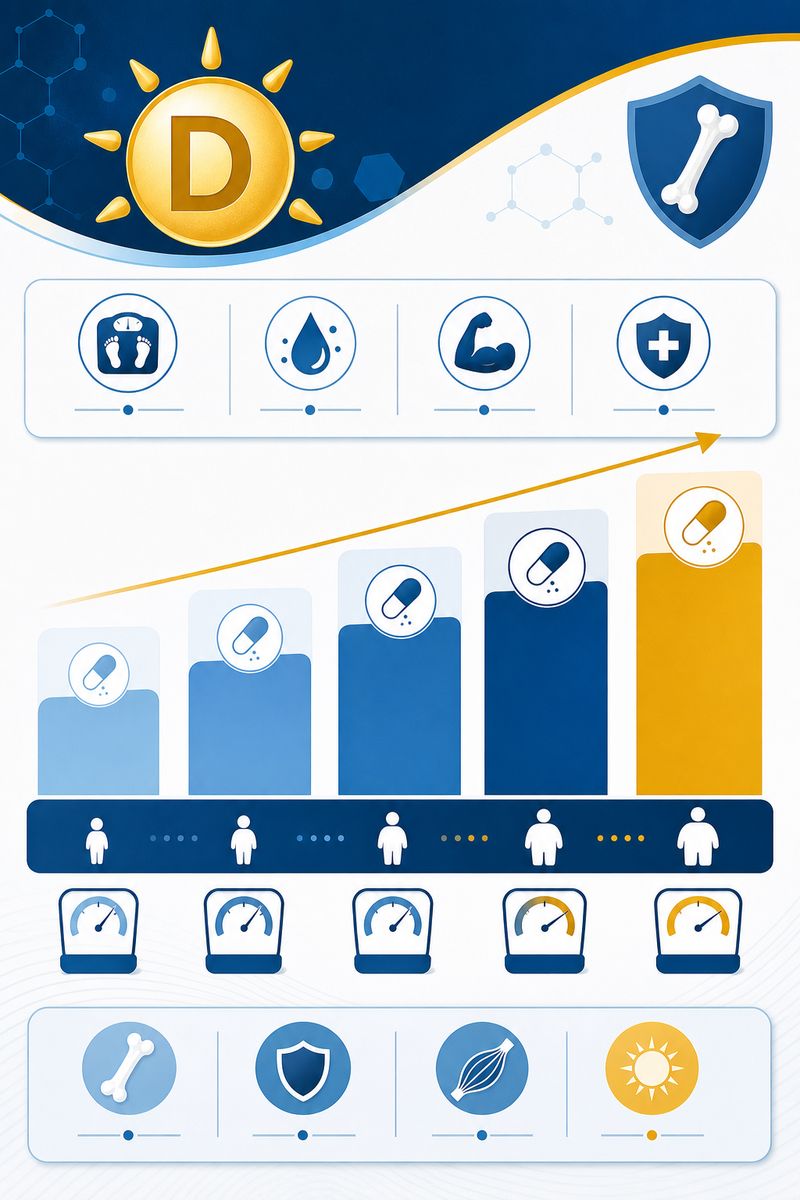
Vitamin D is a fat-soluble secosteroid. Once absorbed or synthesised, it distributes throughout adipose tissue, muscle, and serum. In individuals with higher adiposity, a greater proportion of total-body vitamin D is sequestered in fat stores, reducing the circulating fraction. This phenomenon -- termed volumetric dilution -- is now the leading explanation for the consistently lower serum 25(OH)D levels observed in people with overweight and obesity (Drincic et al., 2012).
The clinical implication is stark: two people taking the same oral dose of cholecalciferol will achieve very different serum levels if their body weights differ substantially.
Clinical pearl: When a patient with BMI above 30 reports that vitamin D supplementation "does not work for me," do not dismiss the observation. The dose is almost certainly too low for their distribution volume. Volumetric dilution is pharmacokinetics, not non-compliance.
A landmark analysis of the VITAL trial, published in JAMA Network Open in 2023, examined this directly. Tobias and colleagues studied 16,515 participants randomised to 2,000 IU/day of vitamin D3 or placebo, stratifying outcomes by BMI. They found that participants with BMI of 30 kg/m2 or above achieved significantly smaller increases in serum 25(OH)D, 1,25(OH)2D, and parathyroid hormone suppression compared with normal-weight participants receiving the identical dose. The blunted response was dose-dependent across BMI categories: overweight individuals showed an intermediate attenuation, whilst those with class II obesity showed the most pronounced blunting (Tobias et al., 2023).
The mechanism matters. This is not a metabolic defect -- it is simple pharmacokinetics. A larger distribution volume means the same dose yields a lower serum concentration. A parallel study by Sadat-Ali and colleagues (2021) put this into practice: they randomised obese women (mean BMI approximately 32 kg/m2) whose vitamin D had been repleted to 30 ng/mL or above (75 nmol/L) into two maintenance arms. Those receiving a fixed 2,000 IU/day saw their levels fall back to 22.8 ng/mL (57 nmol/L) -- insufficiency range -- within three months. Those receiving a BMI-adjusted dose of 125 IU/kg/m2 (average approximately 3,984 IU/day) maintained levels at 34 ng/mL (85 nmol/L). The difference was highly significant (P < 0.001).
A practical dosing framework
Several systematic reviews and expert consensus statements now converge on the same multipliers:
- Normal-weight adults (BMI 18.5-24.9 kg/m2): Standard dosing applies. For maintenance, 600-2,000 IU/day depending on baseline status and sun exposure. The UK RNI of 10 ug (400 IU) per day is a _minimum_ safety net, not a therapeutic or optimisation dose.
- Overweight adults (BMI 25.0-29.9 kg/m2): Approximately 1.5x the standard dose. If a normal-weight individual requires 2,000 IU/day for maintenance, an overweight individual may need 3,000 IU/day.
- Adults with obesity (BMI 30 kg/m2 or above): Approximately 2-3x the standard dose. A maintenance requirement of 4,000-6,000 IU/day is not uncommon.
These are not arbitrary figures. The 1.5x and 2-3x multipliers reflect the pooled evidence across multiple dose-response studies, including the dose-response curve published by Ekwaru et al. (2014) from Canadian Health Measures Survey data, which estimated that obese individuals require roughly 2.5x the vitamin D intake of normal-weight individuals to achieve equivalent serum 25(OH)D concentrations.
The Endocrine Society's 2024 clinical practice guideline -- whilst controversial for its shift away from routine screening in asymptomatic populations -- acknowledges this principle explicitly for patient management: individuals with obesity being treated for deficiency require higher doses, and weight-based adjustment is reasonable (Dempster et al., 2024).
The NHS does not currently incorporate weight-adjusted dosing into its standard vitamin D prescribing guidance, which recommends fixed loading and maintenance regimens (NENC, 2025; BLMK, 2025). This is a gap that functional-medicine practitioners routinely close in practice.
From the literature: "Volumetric dilution, rather than sequestration, best explains the low vitamin D status of obesity." -- Drincic et al., Obesity 2012
Practice tip: For patients with BMI above 30, use the formula 125 IU per kg of body weight as a practical starting point for maintenance dosing. A 100 kg patient would begin at approximately 4,000 IU/day (after appropriate loading), then adjust based on 12-week re-testing.
Vitamin D as more than a bone vitamin
Conventional medicine tends to frame vitamin D around musculoskeletal endpoints: rickets, osteomalacia, falls risk, and fracture prevention. These are important, but they represent a fraction of what vitamin D does.
The vitamin D receptor (VDR) is expressed in nearly every nucleated cell type. Calcitriol -- the active hormonal form -- regulates over 200 genes, including those involved in immune modulation, cell cycle control, insulin secretion, and neurotransmitter synthesis (Holick, 2024). From a functional-medicine standpoint, adequate vitamin D status supports:
- Innate and adaptive immune competence. Vitamin D upregulates cathelicidin and defensins -- endogenous antimicrobial peptides -- and modulates T-regulatory cell function, reducing inappropriate inflammatory responses.
- Insulin sensitivity. Observational and interventional data link low 25(OH)D to impaired glucose tolerance, and supplementation trials show modest improvements in HOMA-IR, particularly in individuals with baseline deficiency and elevated BMI.
- Mood and cognition. VDRs are densely expressed in the prefrontal cortex and hippocampus. Seasonal affective symptoms that linger into late spring often have a nutritional component beyond light exposure alone.
- Muscle function and recovery. Vitamin D influences calcium handling in skeletal muscle and may reduce post-exercise muscle damage when status is optimised.
At a glance -- Vitamin D beyond bone health:
Immune competence (cathelicidin, defensins, T-regulatory cells). Insulin sensitivity (HOMA-IR improvement in deficient individuals). Mood and cognition (VDRs in prefrontal cortex, hippocampus). Muscle function and recovery (calcium handling in skeletal muscle). Each of these systems is compromised by the volumetric dilution effect in higher-BMI individuals.
The spring reset, then, is about more than "topping up." It is about recalibrating a regulatory molecule that touches nearly every system. And for patients carrying extra adipose tissue, the calibration requires a different starting dose. This is relevant for perimenopausal women in particular, where declining oestrogen compounds the metabolic consequences of suboptimal vitamin D status.
A practitioner's guide to the post-winter vitamin D audit
If you are working with patients -- or managing your own health -- here is a practical, evidence-informed sequence for late spring.
Figure: Post-Winter Vitamin D Reset -- 5-Step Timeline
Description: A horizontal timeline spanning from late March to mid-September, divided into five sequential steps. Step 1 (Week 0): "Test 25(OH)D" -- blood draw icon. Step 2 (Weeks 1-6): "Loading phase" -- ascending dose bar, with BMI-adjusted multipliers annotated (1x, 1.5x, 2-3x). Step 3 (Week 7 onward): "Maintenance dose" -- flat dose bar at BMI-stratified level. Step 4 (continuous): "Cofactors" -- magnesium and K2 icons running alongside the entire maintenance period. Step 5 (Week 12): "Re-test 25(OH)D" -- blood draw icon with target range 100-150 nmol/L annotated.
Legend: Each step is sequential. BMI multipliers (1x / 1.5x / 2-3x) indicate the dose adjustment relative to the standard normal-weight dose. The cofactor bar runs continuously from the start of loading.
Interpretation: The timeline illustrates that vitamin D optimisation is not a single-dose event but a structured 12-week cycle of testing, loading, maintaining with cofactors, and re-testing. The BMI-adjusted multipliers are the critical differentiator from standard NHS prescribing.
Step 1: Test, do not guess
Whilst the 2024 Endocrine Society guideline recommends against routine 25(OH)D screening in asymptomatic general-population adults, functional-medicine practice differs. If a patient has fatigue, low mood, recurrent infections, muscle aches, or any metabolic comorbidity -- or if they simply have not seen the sun meaningfully for six months -- testing is justified. For guidance on where vitamin D sits within a broader functional medicine lab-ordering framework, see the lab-ordering pyramid.
The marker to request is serum 25-hydroxyvitamin D (25[OH]D), not 1,25-dihydroxyvitamin D. Optimal functional ranges are generally considered:
Step 1: Test, do not guess
| Status | 25(OH)D (nmol/L) | 25(OH)D (ng/mL) |
|---|---|---|
| Deficient | <30 | <12 |
| Insufficient | 30-75 | 12-30 |
| Sufficient (conventional) | >50 | >20 |
| Optimal (functional) | 100-150 | 40-60 |
| Potentially toxic | >375 | >150 |
Legend: nmol/L is the UK standard unit; ng/mL is used in US and some international literature. Multiply ng/mL by 2.5 to convert to nmol/L. "Sufficient (conventional)" reflects the threshold used by most NHS and NICE guidance; "Optimal (functional)" reflects the range targeted in functional medicine practice.
Interpretation: Most British adults entering spring fall in the Insufficient band (30-75 nmol/L). The functional target of 100-150 nmol/L is an expert-consensus position, not a NICE-endorsed threshold -- communicate this distinction clearly to patients.
Step 2: Calculate the repletion dose
If a patient is deficient or insufficient, a loading phase is often appropriate. The NHS loading regimen of 300,000 IU divided over 6-7 weeks (approximately 50,000 IU/week) is a reasonable starting point for normal-weight adults. For patients with overweight or obesity, consider extending the loading phase or increasing the weekly dose in line with BMI-adjusted requirements.
A pragmatic approach: for every 2.5 nmol/L (1 ng/mL) you wish to raise 25(OH)D, approximately 100 IU/day of additional cholecalciferol is required in a normal-weight adult. Multiply this by 1.5 for overweight, 2.0-2.5 for obesity.
Step 3: Pick the right maintenance dose
Once serum levels are in the optimal range, transition to maintenance. Use the BMI-stratified multipliers above. For a patient with BMI 34 kg/m2 who maintains well on 3,500 IU/day, do not step down to a "standard" 1,000 IU -- the volumetric dilution effect has not changed.
Step 4: Pair with key cofactors
Vitamin D metabolism depends on magnesium at multiple enzymatic steps, including the conversion of cholecalciferol to 25(OH)D in the liver (via CYP2R1) and the subsequent 1-alpha-hydroxylation to active calcitriol in the kidney. Magnesium inadequacy -- common in Western diets -- can blunt the response to supplementation. Ensuring adequate magnesium intake (dietary or supplemental, 200-400 mg/day of elemental magnesium) is a simple lever that improves vitamin D economy. Magnesium is also a critical cofactor in mitochondrial energy production, making it a high-yield target across multiple systems.
Vitamin K2 also deserves mention. By activating matrix Gla protein and osteocalcin, vitamin K2 helps direct calcium into bone rather than soft tissues -- a relevant consideration when supplementing vitamin D at higher doses over the long term.
Caution: Magnesium inadequacy can mask the response to vitamin D supplementation. If a patient's 25(OH)D is not improving despite adequate cholecalciferol doses, assess magnesium status before increasing the vitamin D dose further.
Step 5: Re-test at 12 weeks
Serum 25(OH)D reaches steady state approximately 12 weeks after a dose change. Re-testing at this interval closes the loop and confirms whether the BMI-adjusted strategy has landed the patient in the optimal range. Adjust as needed.
Two patients, same dose, different outcomes
Consider two patients seen in clinical practice last spring -- both female, both 45 years old, both with baseline 25(OH)D of 32 nmol/L in early March.
Patient A: BMI 22 kg/m2. Prescribed 2,000 IU/day cholecalciferol. At 12-week follow-up in June, 25(OH)D was 88 nmol/L -- comfortably within the optimal functional range. No additional supplementation required beyond maintenance.
Patient B: BMI 34 kg/m2. Prescribed the identical 2,000 IU/day. At 12-week follow-up, 25(OH)D was 48 nmol/L -- still insufficient. She reported continued fatigue and two upper respiratory tract infections during the spring months. Her dose was adjusted to 4,500 IU/day (approximately 2.25x the standard maintenance dose). At 24-week follow-up in September, 25(OH)D was 102 nmol/L, and her fatigue and infection frequency had both improved.
The lesson is not that Patient B was non-adherent or had a "resistant" physiology. The lesson is that the same dose in a larger distribution volume yields a lower serum concentration. This is not a failure of the patient -- it is a failure of one-size-fits-all dosing.
Evidence strength for vitamin D interventions
Evidence strength for vitamin D interventions
| Intervention | Evidence tier | Key sources |
|---|---|---|
| BMI-adjusted maintenance dosing | Strong (RCT) | Sadat-Ali et al. 2021; Tobias et al. 2023 |
| Volumetric dilution as the primary mechanism | Strong (mechanistic + clinical) | Drincic et al. 2012 |
| Dose-response curve by body weight | Strong (population study) | Ekwaru et al. 2014 |
| Magnesium as a cofactor for vitamin D metabolism | Moderate (mechanistic + observational) | NIH ODS 2026 |
| Vitamin K2 for calcium direction at higher doses | Moderate (mechanistic + small RCTs) | Multiple small trials |
| 25(OH)D optimal range 100-150 nmol/L | Emerging (expert consensus) | Holick 2024; Endocrine Society 2024 |
Legend: Evidence tiers: Strong = supported by RCTs, systematic reviews, or large population studies; Moderate = supported by mechanistic data plus observational or small RCTs; Emerging = supported by expert consensus or limited clinical validation only.
Interpretation: The core clinical message -- that BMI-adjusted dosing is necessary -- rests on strong RCT evidence. Cofactor pairing (magnesium, K2) has moderate support. The functional-medicine optimal range of 100-150 nmol/L is an expert-consensus position and should be communicated as such to patients.
From the literature: "Participants with BMI of 30 kg/m2 or above achieved significantly smaller increases in serum 25(OH)D, 1,25(OH)2D, and parathyroid hormone suppression compared with normal-weight participants receiving the identical dose." -- Tobias et al., JAMA Network Open 2023
Five practical tips for your post-winter vitamin D reset
- Test before you supplement. A finger-prick or venous 25(OH)D test costs less than a year's worth of unnecessary high-dose supplementation -- and far less than the cost of remaining deficient.
- Know your BMI category and adjust accordingly. If your BMI is above 25 kg/m2, you almost certainly need more than the standard dose to reach and maintain optimal levels.
- Take vitamin D with a meal containing fat. Cholecalciferol absorption is bile-acid-dependent and significantly improved by concurrent dietary fat intake -- a 2010 study demonstrated 32% better absorption when taken with a fat-containing meal versus on an empty stomach.
- Do not neglect magnesium. Without adequate magnesium, vitamin D cannot be fully activated. Leafy greens, nuts, seeds, and -- if needed -- a magnesium glycinate or citrate supplement provide the cofactor support.
- Re-test at 12 weeks. Vitamin D status changes slowly. A single test followed by indefinite supplementation without follow-up is a missed opportunity to personalise the dose.
When to seek professional guidance
Safety note: Individuals with sarcoidosis, primary hyperparathyroidism, or granulomatous disorders must not supplement vitamin D without specialist oversight. These conditions involve dysregulated 1-alpha-hydroxylase activity, meaning even modest doses can cause hypercalcaemia. Always screen for these conditions before initiating higher-dose protocols.
Vitamin D is safe within a wide therapeutic window, but it is not harmless at extremes. Doses above 4,000 IU/day sustained over months should be monitored. Individuals with sarcoidosis, primary hyperparathyroidism, or certain granulomatous disorders should not supplement without specialist oversight, as they may develop hypercalcaemia even at modest doses.
If you are taking multiple supplements, managing a chronic condition, or simply unsure where to start, a functional-medicine practitioner can help you navigate the testing and dosing decisions that make the difference between guessing and optimising.
For anyone experiencing persistent fatigue that does not resolve with vitamin D repletion, a broader investigation -- including thyroid and metabolic panels and, where indicated, __LINK_9c905dadd9e5__ -- may be warranted.
In a mental health crisis, contact Samaritans on 116 123 (free, 24/7), text SHOUT to 85258, call NHS 111 (urgent non-emergency), or call 999 (emergency).
This article was written by Chris Massamba (Dip CNM, FMCHC), Functional Nutritionist & Health Coach. It is for educational purposes and does not constitute individual medical advice. Always consult a qualified healthcare professional before starting a new supplement regimen, particularly if you have a pre-existing health condition or are taking prescribed medication.
Related reading
- The 5R Gut Health Protocol -- vitamin D supports gut barrier repair (Phase 4: Repair).
- Essential Functional Medicine Laboratory Tests for 2026 -- how 25(OH)D fits into the lab-ordering pyramid.
- Perimenopause Nutrition: Alcohol, Fibre, Protein, and Omega-3 -- vitamin D's role in perimenopausal bone and immune health.
- Mitochondrial Restoration Protocol -- vitamin D and energy production via mitochondrial membrane function.
- CGM in Functional Practice -- metabolic monitoring for patients with insulin resistance and vitamin D insufficiency.
- Dietary Guidance 2025-2030 -- the broader policy context for micronutrient recommendations.
When the picture is complex, multi-system, or beyond the scope of self-interpretation, please work with a registered practitioner. Find an EPINUTRI practitioner.
Practitioner summary
- Test serum 25(OH)D before supplementing -- do not guess baseline status, especially after winter at UK latitudes.
- Apply BMI-stratified dosing: 1.5x standard for overweight (BMI 25-29.9), 2-3x for obesity (BMI 30+). A fixed 2,000 IU/day leaves many heavier patients insufficient.
- Use the NHS loading regimen (300,000 IU over 6-7 weeks) as a starting point for normal-weight adults; extend or increase for higher BMI categories.
- Pair vitamin D with magnesium (200-400 mg/day elemental) -- magnesium is required at multiple enzymatic steps in vitamin D metabolism.
- Consider vitamin K2 alongside higher-dose vitamin D supplementation to direct calcium into bone rather than soft tissues.
- Advise patients to take cholecalciferol with a fat-containing meal for optimal absorption.
- Re-test 25(OH)D at 12 weeks post-dose change to confirm the BMI-adjusted strategy has achieved the target range.
- Do not step down maintenance dose to "standard" once levels are optimal -- volumetric dilution is ongoing; the higher maintenance requirement persists.
- Monitor patients taking above 4,000 IU/day sustained; refer individuals with sarcoidosis, primary hyperparathyroidism, or granulomatous disorders to specialist care before supplementing.
- When vitamin D repletion alone does not resolve fatigue, escalate to thyroid panel, metabolic screening, and mitochondrial function assessment.
References
- [1]BLMK Area Prescribing Committee (2025) ‘Guideline for the Management of Vitamin D Deficiency in Adults’, May. medicines.bedfordshirelutonandmiltonkeynes.icb.nhs.uk
- [2]Dempster DW, Rosen CJ, Bilezikian JP, et al (2024) ‘Vitamin D for the Prevention of Disease: An Endocrine Society Clinical Practice Guideline’, *J Clin Endocrinol Metab*. doi:10.1210/clinem/dgae290
- [3]Drincic AT, Armas LAG, Van Diest EE, Heaney RP (2012) ‘Volumetric dilution, rather than sequestration best explains the low vitamin D status of obesity’, *Obesity (Silver Spring)*. doi:10.1038/oby.2011.404
- [4]Ekwaru JP, Zwicker JD, Holick MF, Giovannucci E, Veugelers PJ (2014) ‘The importance of body weight for the dose response relationship of oral vitamin D supplementation and serum 25-hydroxyvitamin D in healthy volunteers’, *PLoS One*. doi:10.1371/journal.pone.0111265
- [5]Holick MF (2024) ‘Revisiting Vitamin D Guidelines: A Critical Appraisal of the 2024 Endocrine Society Clinical Practice Guideline’, *Endocr Pract*. doi:10.1016/j.eprac.2024.09.009
- [6]National Institute for Health and Care Excellence (2026) ‘Vitamin D deficiency in adults (CKS)’, Available at: https://cks.nice.org.uk/topics/vitamin-d-deficiency-in-adults/ (Accessed: 28 May. cks.nice.org.uk
- [7]National Institutes of Health, Office of Dietary Supplements (2026) ‘Vitamin D: Fact Sheet for Health Professionals’, Available at: https://ods.od.nih.gov/factsheets/VitaminD-HealthProfessional/ (Accessed: 28 May. ods.od.nih.gov
- [8]National Institutes of Health, Office of Dietary Supplements (2026) ‘Magnesium: Fact Sheet for Health Professionals’, Available at: https://ods.od.nih.gov/factsheets/Magnesium-HealthProfessional/ (Accessed: 28 May. ods.od.nih.gov
- [9]North East and North Cumbria (NENC) ICB (2025) ‘Primary Care Management of Vitamin D Deficiency in Adults’, March. ntag.nhs.uk
- [10]SACN (Scientific Advisory Committee on Nutrition) (2016) ‘Vitamin D and Health’, London: Public Health England. assets.publishing.service.gov.uk
- [11]Sadat-Ali M, AlTabash KW, Al-Turki HA, AlMousa SA, AlSayed HN (2021) ‘Time out: should vitamin D dosing be based on patient's body mass index (BMI): a prospective controlled study’, *J Nutr Sci*. doi:10.1017/jns.2021.100
- [12]Stewart Nutrition0 ‘Deficiency Symptoms and Signs (practitioner reference guide)’, Available at: http://www.stewartnutrition.co.uk/nutritional_assesment/deficiency_symptoms_and_signs.html. www.stewartnutrition.co.uk
- [13]Tobias DK, Luttmann-Gibson H, Mora S, et al (2023) ‘Association of Body Weight With Response to Vitamin D Supplementation and Metabolism’, *JAMA Netw Open*. doi:10.1001/jamanetworkopen.2022.50681
Written by

Chris Massamba
Functional Nutritionist & Health Coach · Dip CNM · FMCHC
Medical disclaimer: The content in this article is for informational purposes only and does not constitute medical advice, diagnosis, or treatment. Always consult a qualified healthcare professional before making any changes to your health regimen. Individual results may vary. If you are experiencing a medical emergency, please contact 999 immediately.
Related Protocols
- Gut Healthstrong
- Leaky Gut Supportmoderate
- Dysbiosis Managementmoderate
Related Articles

NutritionExpert Opinion
New Dietary Guidance 2025-2030: Why Federal Recommendations Now Align with Functional Medicine
The five shifts that matter Legend: "2020-2025 guidance" and "2025-2030 guidance" compare the previous and current feder...
Chris Massamba30 May 202616 min
NutritionRCT
Essential Functional Medicine Laboratory Tests for 2026: A Practitioner Guide
Why advanced testing matters in 2026 Laboratory testing remains one of the most useful tools in functional medicine -- b...
Chris Massamba30 May 202623 min
NutritionSystematic Review
Dietary Guidance 2025-2030: What Functional Medicine Practitioners Need to Know
The Shifting Landscape of Dietary Guidance The 2025-2030 dietary guidelines represent a significant evolution in mainstr...
Chris Massamba8 May 202610 min